Aatcheeswarar temple, Achchirupakkam
Location
Ach-Chiru-Paakkam
Deity
Aatcheeswarar, Umaiyatchiswarar
Female Deity
Umayaambikai
Pathikam
Sambandar - 1
Gallery – Atcheeswarar Temple, Achchirupakkam


How to Reach
Achirupakkam lies on the Southern Railway’s Chengalpattu–Villupuram line, though most trains do not stop here and instead halt at the nearby Melmaruvathur station, about 4 km away. By road, the town is located on the Chennai–Tindivanam National Highway (NH-45). Achirupakkam is around 96 km from Chennai and about 15 km from Maduranthakam, making it easily accessible by road.
Temple Address
Acharapakkam Post
Madurantakam Taluk
Kanchipuram District
PIN – 603301
Temple Hours
Morning : 6:30 - 12:00
Evening : 4:00 - 8:30
Contact
Shankar Gurukkal
98423 09534
Legend – Origin of the Name
According to legend, the three asuras Vidyunmali, Tharukaksha, and Kamalaksha ruled the invincible Tripura—three moving cities made of gold, silver, and iron—and caused great suffering to the devas. Seeking relief, the devas appealed to Shiva, who prepared to destroy them with a divine chariot built from cosmic elements: the four Vedas as horses, Brahma as the charioteer, the sun and moon as the wheels, and other beings forming the chariot and army. However, because the devas had neglected to worship Vinayaka before beginning the mission, the axle of Shiva’s chariot broke. Realizing the reason, Shiva prayed to Ganesha, who repaired the axle, enabling Shiva to proceed and destroy the demons. It is believed that this place, where the axle (Acchu) broke (Iru Pakam), came to be known as Achirupakkam. Another legend says that the axle of a Pandya king’s chariot also broke here while he was transporting soil from the Ganges to build a dam, further associating the place with this name.
The Temple
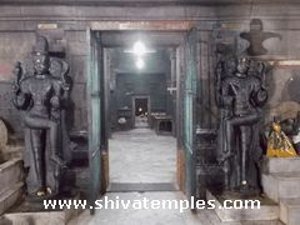
The Shiva temple at Achirupakkam is distinguished by its majestic five-tiered east-facing Rajagopuram, which serves as the main entrance to the temple. After passing through this gateway, devotees reach an inner entrance. Unlike most Shiva temples where the balipeetam, dwajasthambam, and Nandi are aligned directly with the main entrance, in this temple they are placed slightly to the left side. A unique feature of this temple is the presence of two main sanctums. The inner entrance directly opposite the Rajagopuram leads to the sanctum of Umayatcheeswarar, while the sanctum of the presiding deity Atcheeswarar lies across the balipeetam, dwajasthambam, and Nandi. Atcheeswarar appears as a self-manifested (Swayambhu) Linga facing east. Guarding the sanctum entrance are the defeated demons Tharukaksha and Vidyunmali, serving as the Dwarapalakas. Nearby are the sannidhis of Vinayaka and Muruga with His consorts Valli and Deivanai. The temple’s Goshta deities include Dakshinamurthy, Mahavishnu, Brahma, and Goddess Durga, and a pradakshina path surrounds the sanctum of Atcheeswarar for devotees to circumambulate the deity.
On either side of the pathway leading to the sanctum of Umayatcheeswarar, there are sannidhis dedicated to Alamelumangai, Srinivasa Perumal, Palani Andavar, the Urchava idols, Lakshmi, Saraswathy, and Arumukhaswamy. Inside the east-facing sanctum, behind the Linga of Umayatcheeswarar, devotees can see a depiction of Shiva and Parvathy in their divine wedding form (Tirumanakolam). Tradition holds that Sage Agasthya was granted the sacred vision of the celestial wedding of Shiva and Parvathy at Achirupakkam. Close by is the south facing sannidhi of Umayambikai.
Kondraiyadi Eeswarar & Ilankili Ammai
In the northern outer prakaram of this temple stands the sacred Sarakondrai tree (golden shower tree), beneath whose shade the deity Kondrai-adi-Eeswarar is worshipped. Nearby are the idols of Nandikeshwarar and Sage Tri-Nethra-dari. According to legend, it was under this very tree that Shiva manifested before a Pandya king, instructing him to build a temple in His honour. The king entrusted the task to Sage Tri-Nethra-dari, who happened to be present there. The sage constructed the temple with two separate sanctums, and when the king asked the reason, he explained that he had installed two deities—Umayatcheeswarar for the king and Atcheeswarar for himself, as both of them had been blessed by the deity at that spot.
In the north-eastern corner of the northern prakaram, is south facing sannidhi for the goddess Ilankili Ammai.
Achumuri Vinayaka
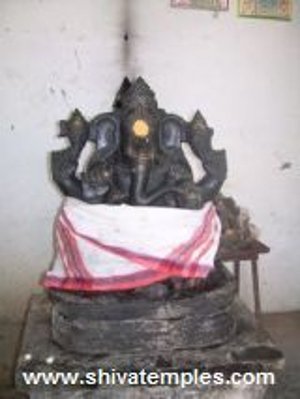
A separate sannidhi in the temple is dedicated to “Achumuri Vinayakar,” the Vinayaka who caused the axle of Lord Shiva’s chariot to break during the Tripurasamhara episode. It is widely believed that worshipping Achumuri Vinayakar before starting any new venture will ensure that it proceeds smoothly without obstacles. The significance of this deity is further highlighted by Saint Arunagirinathar, who began his Tirupugazh by praising this Vinayaka. In his Vinayakar thuthi Kaithala Nirai Kani, he refers to the Tripurasamhara legend in the line Muppuram eri seidha, Achchivan urai ratham, Achadu podi seida athi dheera.
Tripura Samhara
The Three Demons of Tripura
According to legend, three formidable demons—Vidyunmali, Tarukaksha, and Kamalaksha—resided in three impregnable, moving fortresses collectively known as Tripura. These celestial cities, fashioned from gold, silver, and iron, drifted through the skies, beyond the reach of ordinary weapons. From their invincible strongholds, the demons spread destruction across the universe, relentlessly tormenting the Devas. Unable to endure their suffering any longer, the distressed celestial beings sought refuge in God Shiva, earnestly appealing to him to destroy the tyrants and restore peace and balance.
The Divine Chariot
Answering their plea, a resplendent celestial chariot was prepared for the divine mission. The four Vedas transformed into four mighty horses to draw it, while Brahma assumed the role of charioteer. The Sun and the Moon became the right and left wheels, and beings from across the worlds gathered to adorn the chariot, forming a vast divine army. Each participant took pride in their role, convinced that their individual contribution would secure victory. Watching this quiet rise of arrogance, Shiva simply smiled—his calm, knowing expression a subtle reminder that all power ultimately rests with him alone.
The Benevolent Smile
That radiant smile of Shiva poured divine grace across all the worlds. Among the inhabitants of Tripura, those demons who remained steadfast in their devotion to him were granted protection and well-being, while those who turned away from devotion met their inevitable end. With nothing more than a gentle, effortless chuckle, Shiva reduced the three mighty fortresses to dust, marking the ultimate triumph of good over evil and the restoration of cosmic balance.
Temples associated with Tripura Samhara:
The Wedding
During the celestial wedding of Shiva and Parvati at Mount Kailash, the presence of countless gods and sages gathered in the north caused the earth to tilt slightly. To restore balance, Shiva asked the revered sage Agastya to travel to the southern regions. Agastya felt sorrowful at leaving, as he wished to witness the divine marriage. Understanding the sage’s devotion, Shiva granted him a boon that he would be able to behold the sacred wedding from wherever he was and whenever he desired.
Places visited by Sage Agasthya in his journey to south -
Gallery – More Pictures