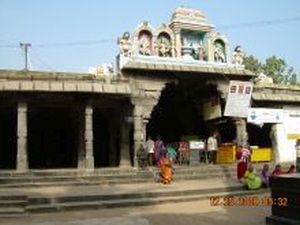
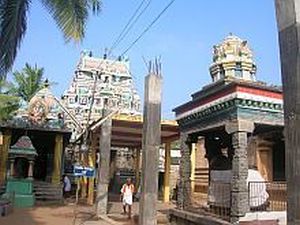
Chandrasekarar temple, Tiruvakkarai
Location
Tiru-Vakkarai
Deity
Chandrasekarar, chandramouleeswarar
Female Deity
Vadivaambikai
Pathikam
Sambandar - 1
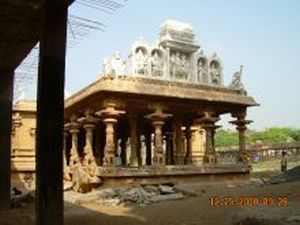
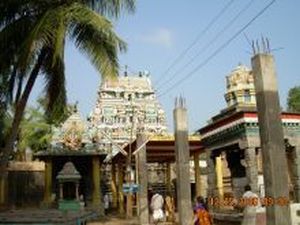
Gallery – Chandrasekarar Temple, Tiruvakkarai
How to Reach
This Shiva temple is situated about 30 km from Tindivanam on the Tindivanam–Pondicherry route via Mayilam, Vaanur, and Perumbakkam. From Perumbakkam, a diversion leads directly to Tiruvakkarai. The temple is also about 29 km from Viluppuram. Another approach is from Pondicherry via the Tirukanur Road (SH 203), which also leads to Tiruvakkarai.
Temple Address
Thiruvakkarai
Vanur Taluk
Villupuram District
PIN – 604304
Temple Hours
Morning : 6:00 - 20:00
Nearby Paadal Petra Shiva Temples
Outer Prakaram – Vakkarakali
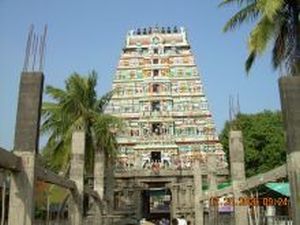
This Shiva temple stands at the foot of a small hill on the banks of the Varaha River and features a majestic 7-tier east-facing Rajagopuram with three prakarams. Just inside the entrance, on the right, is the north-facing sannidhi of Ashtabhuja Kali. According to legend, this is the place where Mahavishnu fought and destroyed the demon Vakrasura. As drops of the demon’s blood fell to the ground, new demons began to arise from each one, and Kali drank the blood to stop them from multiplying. Vakrasura’s younger sister Dunmuki also came to wage war, but she too was vanquished by Ashtabhuja Kali. Since Dunmuki was pregnant at the time, Kali is believed to have protected the fetus by wearing it as an earring while slaying her.
The entrance to Kali’s sannidhi is adorned with sculptures of four Balakis, and the Goddess is worshipped here as Vakkarakali. Devotees come here to visit this sannidhi of kali in large numbers to seek blessings for auspiciousness, progeny, marital harmony, and prosperity. Special pujas are performed on every full moon day. Directly opposite Kali’s sannidhi is the west-facing Vakra Lingam, believed to have been worshipped by the demon Vakrasura. Moving further ahead, a hall with lion-faced pillars can be seen on the right. Nearby stands a three-tiered gopuram known as the Kili Gopuram. In front of this gopuram is a large stone Nandi, and to its left is the sannidhi of Ganesha.
Inner Prakaram – Presiding Deity
After passing through the second gopuram into the inner prakaram, one comes across the Sannidhi of Sage Kundali, where a Shiva Lingam has been installed over the sage’s samadhi. The goshta deities here include Dakshinamurthy, Thirumal, and Varadaraja Perumal, with Garudalwar enshrined opposite them. A Sahasra Lingam is also found here. The sanctum of the presiding deity, Chandrasekarar, is reached by climbing a few steps, with Dwara Balakas standing guard on either side. In the innermost prakaram are the sannidhis and idols of the four principal Nayanmars, Dakshinamurthy, Vinayaka, Arumugha, Goddess Durga, and Chandeshwarar. Enshrined along the rear wall are Brahma, Ardhanareeswarar, and Bhairavar.
The presiding deity, Chandrashekarar, is enshrined as a striking three-faced Lingam, set on a circular Avudaiyar over a square pedestal. The Aghora face, which faces south, is said to reveal two distinct fangs that can be seen only during milk abhishekam. A special feature of this temple is the Jyoti Darshan, which is offered at midnight on Pournami and at noon on Amavasya.
Trimurthi Lingam
Chandrasekarar, the presiding deity, is enshrined here as a rare three-faced Lingam, with one face turned to the east, one to the south, and one to the north. These are identified as the Tatpurusha, Aghora, and Vamadeva aspects respectively, and are believed to symbolize Brahma, Vishnu, and Rudra. The presence of this uncommon Trimurti Lingam makes Tiruvakkarai an especially unique and sacred Shiva temple. In the second prakaram, Varadaraja Perumal, who is believed to have destroyed the demon Vakrasura, stands facing west, holding the Prayoga Chakra in His hand — a rare form found only at this temple.
Unique Vakra Features
Because of its association with the demon Vakra, this place came to be known as Vakkarai. Several features within the temple reflect this vakra (twisted or unusual) aspect. The Nataraja here performs the rare Vakra Thandavam, with the raised right leg lifted high above the hip. In addition, the dwajasthambam, balipeetam, and Nandi are not aligned with the main sanctum, which is considered unusual in temple architecture. Even in the Navagraha Sannidhi, the vahana of Saneeshwara—the crow—faces south, adding to the temple’s distinctive vakra characteristics.
Just about 1 km from the temple is the National Fossil Wood Park, which preserves rare petrified trees estimated to be more than 20 million years old. It is considered one of the few such fossil wood parks in the world.
Gallery – More Pictures