Marundeeswarar temple, Tiruvanmiyur
Location
Tiru-Vanmiyur, in Chennai
Deity
Marundeeswarar
Female Deity
Thri-Pura-Sundari
Pathikam
Tirunavukarasar - 1, Sambandar - 2
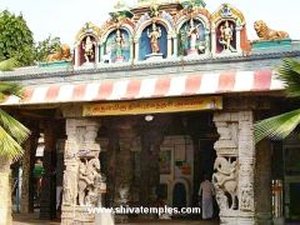
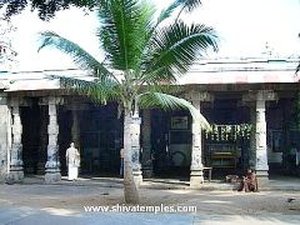
Gallery - Marundeeswarar Temple

How to Reach
This temple is well connected from all parts of Chennai city. It is located within ½ km of the Tiruvanmiyur Bus Terminus.
Temple Address
Thiruvanmiyur
Chennai
PIN – 600041
Temple Hours
Morning : 5:00 - 12:00
Evening : 4:00 - 9:00
Temple Overview
Temple Architecture
The Shiva temple at Tiruvanmiyur is notable for its impressive architectural layout. The temple complex has three main gopurams of varying tiers. The principal seven-tiered Rajagopuram stands on the eastern side, while a five-tiered gopuram is situated within the temple complex. Another five-tiered gopuram on the western side serves as the main entrance and is conveniently located near the Tiruvanmiyur Bus Terminus on the East Coast Road. Entering through the eastern Rajagopuram, visitors come into a spacious courtyard. To the right is the Thyagaraja Mandap, while the temple tank is located to the left. From this courtyard, one can proceed through the second five-tiered gopuram to reach the eastern outer prakaram. Here, the sannidhi of the goddess Tripurasundari is located on the right, facing south, along with separate sannidhis for Vinayaka and Muruga. Entering through the western gateway leads to the western outer prakaram, where the balipeetam, dwajasthambam, and Nandi can be seen. A small entrance next to these leads to the west-facing sannidhi of the presiding deity, Marundeeswarar, who is worshipped in the form of a Swayambhu Linga.
Inner Prakaram
The inner prakaram surrounding the sanctum houses numerous sannidhis. On the western side are the sannidhis of Gajalakshmi, Muthukumaraswamy with Valli and Deivanai, Vinayaka, and the four principal Nayanmars. The northern side of the inner prakaram features the Urchava idols, followed by the majestic presence of Nataraja, 108 Lingas, and Kalabhairavar, exuding a sense of power and protection. Along the eastern side of the inner prakaram are the sannidhis of Kedareeswarar, Ramanatheswarar, Sundareshwarar, Arunachaleswarar, and Jambukeswarar. Meanwhile, the southern side is graced by the presence of all the 63 Nayanmars. The Goshta images further enrich the spiritual ambiance and include Brahma, Goddess Durga, Mahavishnu, Dakshinamurthy, and Ganesha, each contributing to the sanctity of the temple surroundings.
Sthala Puranam
Origin of the Name Marundeeswarar
The presiding deity of this temple is known as Marundeeswarar in Tamil and Aushadhanathar in Sanskrit, both meaning “Lord of Medicines.” Another name of the deity is Paal-vanna-nathar, which means “the one who has the color of milk.” According to legend, the celestial cow Kamadenu once showed disrespect to Sage Vashista, who in turn cursed her to be born on Earth. Realizing her mistake, Kamadenu sought the sage’s forgiveness and pleaded for the curse to be lifted. Sage Vashista then instructed her to go to Vanmiyur and perform abhishekam to the self-manifested Linga there with her milk, assuring her that this act would grant her redemption. Following his advice, Kamadenu poured her milk over the Linga. The Linga turned white due to the milk, and the deity thus came to be known as Paal-vanna-nathar, referring to the milk-like color. This temple site is also closely associated with medicinal knowledge. It is believed that Sage Agathiya, who came here to worship Shiva, received divine knowledge about various diseases and their cures. Because of this connection with healing and medicine, the deity is revered as Marundeeswarar and Aushadhanathar, the deity who grants remedies for ailments.
Sage Agasthya and the Sacred Wedding
During the celestial wedding of Shiva and Parvati at Mount Kailash, the presence of countless gods and sages gathered in the north caused the earth to tilt slightly. To restore balance, Shiva asked the revered sage Agastya to travel to the southern regions. Agastya felt sorrowful at leaving, as he wished to witness the divine marriage. Understanding the sage’s devotion, Shiva granted him a boon that he would be able to behold the sacred wedding from wherever he was and whenever he desired.
Places visited by Sage Agasthya in his journey to south -
- Tiru-Kodunkundram
- Kutralam
- Tiru-Panankattur
- Tiru-Kallil
- Tiru-Votriyur
- Tiru-Verkaadu
- Tiru-Vaanmiyur
- Achirupakkam.
- Tiru-Nallur
- Tiru-Nani-Palli
- Tiru-Aakkur
One such place where Sage Agasthya witnessed the divine Tirumana Kolam (wedding form) of Shiva and Parvathy is Tiruvanmiyur. During his stay there, the sage is believed to have suffered from severe stomach pain. Shiva then appeared before him and imparted knowledge about various medicinal remedies. Because of this divine act of teaching healing methods, the deity came to be worshipped here as Marundeeswarar, the Lord of Medicines. It is also believed that the planetary deities Surya and Chandra worshipped Marundeeswarar at this temple. As a result, the temple does not have a separate sannidhi dedicated to the Navagrahas.
The Sacred Vanni Tree
The sacred Vanni tree, located at the north-western corner of the outer prakaram, holds great religious significance in this Shiva temple. According to tradition, Sage Agasthya received a divine vision of the celestial wedding of Shiva and Parvathy while meditating beneath this ancient tree. Puranic accounts also state that Sage Vanmeeka (Valmiki) was advised by Sage Narada to come to this holy place in search of salvation. It is believed that he discovered the Swayambhu Lingam hidden beneath the Vanni tree and began worshipping it with deep devotion. This sacred tree is believed to have witnessed two divine manifestations of Shiva—first for Sage Agasthya and later for Sage Vanmeeka. In remembrance of the vision granted to Sage Agasthya, an annual ceremony is held beneath this Vanni tree on the ninth day of the Brahmotsavam festival in the Tamil month of Panguni, commemorating Shiva blessing the sage with the sight of the celestial wedding.
Gallery - Marundeeswarar Temple


