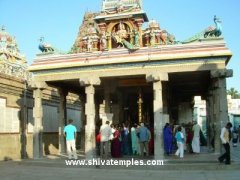
Kabaleeswarar temple, Tirumayilai
Location
Tiru-Mayilai, in Chennai
Deity
Kabaleeswarar
Female Deity
Karpagambal
Pathikam
Sambandar - 1
Gallery - Kabaleeswarar Temple


How to Reach
This Shiva temple is located in Mylapore, a centrally situated neighborhood of Chennai. A suburban railway station known as Tirumayilai on the Chennai Beach – Tiruvanmiyur route is close to the temple.
Temple Address
Mylapore
Chennai
PIN – 600004
Temple Hours
Morning : 5:30 - 12:30
Evening : 4:00 - 9:30
Temple Overview
The phrase “Kayilaye Mayilai, Mayilaye Kayilai” reflects the sanctity of Mylapore, suggesting that Mayilai is as sacred as Mount Kailash. This saying highlights the spiritual importance of the famous Kapaleeshwarar Temple located in the heart of Chennai. The temple is the divine abode of Kabaleeshwarar and Goddess Karpagambal. From the Thevaram hymn composed by Tirugnanasambandar, it can be understood that this region was once filled with lush coconut groves and lay close to the seashore. The present temple structure is believed to be around 300 years old. Temple authorities state that the original temple stood near Santhome Beach before it was destroyed by the Portuguese. References in the works of Arunagirinathar also suggest that the ancient temple was located nearer to the coastline. The temple hosts many festivals throughout the year, among which the grand Brahmotsava festival celebrated in the Tamil month of Panguni is especially significant and attracts large numbers of devotees
Temple Architecture
The eastern gateway serves as the main entrance to the temple and is crowned by an impressive 120-feet-tall, seven-tiered rajagopuram. This entrance leads into a spacious outer prakaram, where the sannidhis of Annamalayar, Narthana Vinayaka, Jagadeeshwara, and the Navagrahas are arranged in sequence, all facing east. Proceeding in a clockwise direction around the outer prakaram, on the southern side one comes across the Navarathri Mandapam, a pillared hall that faces east. Nearby is a sannidhi for Muruga as Singara Velar, depicted with six divine faces and twelve hands, accompanied by his consorts Valli and Deivanai, gracefully seated on an elephant. The revered saint-poet Arunagirinathar composed ten hymns in praise of Muruga of this temple, which are included in the sacred Tiruppugazh collection associated with the temple complex of Kapaleeshwarar Temple in Mylapore.
Continuing along the southern prakaram and turning right into the western outer prakaram, one reaches the western gateway, which serves as an alternative entrance to the temple. Directly opposite this gateway stand the Dwajasthambam (flagstaff), balipeetam, and Nandi. Nearby is the entrance leading to the sannidhi of the presiding deity at the renowned Kapaleeshwarar Temple in Mylapore. To the left of this entrance is the passage leading to the south-facing sannidhi of Goddess Karpagambal, whose divine beauty is greatly revered by devotees. Both the sanctums of Kapaleeshwarar and Karpagambal have their own inner prakarams that devotees use for pradakshina (circumambulation). The presiding deity, Kapaleeshwarar, is worshipped as a self-manifested (swayambhu) Shiva Linga facing west within the sanctum. Along the circumambulatory pathway surrounding the sanctum are idols of Bhairavar, Veerabhadrar, the three principal Nayanmars—Appar (Tirunavukkarasar), Tirugnanasambandar, and Sundarar—as well as the revered group of the 63 Nayanmars.
Inner Prakaram
At the southwest corner of the prakaram in Kapaleeshwarar Temple, there is a small sannidhi dedicated to Arunagirinathar, positioned facing Singara Velar. The temple’s sthala vruksham is the sacred Punnai tree, located in the northern prakaram. Nearby is a sannidhi for Punnaivananathar. According to temple tradition, Shiva appeared beneath this tree for Goddess Parvathy. Behind the sannidi of Punnaivananathar, a sculpture depicting a Shiva Linga along with a peacock can be seen, symbolizing the divine legend associated with this temple. In the north-eastern corner of the prakaram, there is also a west-facing sannidhi dedicated to Saneeshwara, where devotees offer prayers seeking relief from the effects associated with the planet Saturn.
Reason for the Name
According to temple legend, Brahma, the god of creation, once possessed five faces similar to those of Shiva. At the end of every Yuga, Brahma’s life cycle concludes, and a new Brahma emerges at the beginning of the next Yuga. This cyclical existence stands in contrast to Shiva’s eternal nature, which is without beginning or end. Unaware of his own impermanence, Brahma grew proud of having five faces like Shiva. To humble him, Shiva removed one of Brahma’s heads (known as Kabalam). Because of this act, Shiva came to be known as Kabala Eeswarar, a name that gradually evolved into Kabaleeshwarar.
Temple Legends
Parvathy and the Peacock
According to temple legend associated with Kapaleeshwarar Temple, at the request of Parvati, Shiva explained the significance of the sacred five-syllable mantra “Shi-va-ya-na-ma.” During this moment, however, Parvathy’s attention was briefly drawn to the graceful movements of a peacock nearby. Seeing this distraction, Shiva transformed her into a peacock—the very form that had captivated her. Realizing her mistake, Parvathy prayed to Shiva for forgiveness. Shiva then instructed that she could attain liberation by worshipping Him while in the form of a peacock. Following His guidance, the goddess came to this sacred place and performed her penance and worship here as a peacock. Because of this divine legend, the place came to be known as Thirumayilai—“Tiru” meaning sacred and “Mayil” meaning peacock—referring to the site where the goddess worshipped Shiva in the form of a peacock in present-day Mylapore.
Poompavai and Tirugyanasambandhar
In the sacred town of Mylapore (Tirumayilai), there once lived a devout Shiva bhakta named Shivanesa Chettiar, who worshipped Shiva with great devotion. He had a daughter named Poompavai and wished that she would marry the saint Tirugnanasambandar. However, tragedy struck when Poompavai was bitten by a snake while working in her garden and passed away. Even in his grief, Shivanesar firmly believed that his daughter was destined to be united with the saint. He carefully preserved her ashes in a small vessel. Later, when Shivanesar met Tirugnanasambandar at Tiruvotriyur, he narrated the sorrowful story of his daughter and presented the vessel containing her ashes, expressing his wish that she be united with the saint. Moved by Shivanesar’s unwavering faith and devotion, Tirugnanasambandar prayed to Shiva at the revered Kapaleeshwarar Temple and sang sacred hymns in praise of the deity. By the grace of Shiva, a miracle occurred—Poompavai emerged alive from the vessel. When Shivanesar then requested the saint to marry her, Tirugnanasambandar gently declined, explaining that since he had restored her life through divine grace, he now stood in the position of a father to her. Accepting this, Poompavai chose to remain unmarried and devoted the rest of her life to the service of God Shiva.
Adjacent to the western gopuram of the renowned Kapaleeshwarar Temple is a sannidhi dedicated to Poompavai, where Tirugnanasambandar is also depicted alongside her. The remarkable event of Sambandhar reviving Poompavai is commemorated annually during the Brahmotsavam festival held in the Tamil month of Panguni. This special ritual takes place on the morning of the eighth day of the festival. On this occasion, Sambandhar, Poompavai, Shivanesa Chettiar, and the temple’s utsava (processional) idols are ceremoniously taken to the Kabali Theertham. As part of the ritual reenactment, a ceremonial vessel called a kumbha is filled with sugar instead of ashes, symbolizing the sacred event. The Pathikam composed by Sambandhar is then sung, and the moment of Poompavai’s revival is symbolically recreated. Devotees believe that witnessing this sacred ceremony brings blessings of longevity. Because of this belief, the temple is considered especially auspicious for celebrating milestone birthdays such as the 60th (Shashtiabdapoorthi) and the 80th (Sathabhishekam), and many devotees choose this sacred place in Mylapore for such celebrations.
The Tirumurai Festival
The Tirumurai festival is one of the important celebrations associated with the annual Brahmotsavam at the renowned Kapaleeshwarar Temple in Mylapore. A major highlight of this festival is the grand procession of the idols of the 63 Nayanmars, the revered saints of the Shaiva tradition, which draws large numbers of devotees. Another significant observance takes place on the full moon day of the Tamil month of Masi, when the urchava idol is ceremonially taken to the seashore for a ceremonial bath. This festival tradition is also reflected in the hymns of Tirugnanasambandar. In his pathikam found in the Second Tirumurai, he describes the glory of the temple and the vibrant festivals celebrated there. His verses mention devotees bathing in the sea while facing the deity, set amidst the serene surroundings of coconut groves that once flourished in the region. Sambandhar’s hymns also poignantly refer to the story of Poompavai, who tragically died from a snake bite before she could witness the temple’s grand festivals. These verses highlights the cultural and spiritual significance of Tirumayilai as a center of devotion and celebration throughout the year.
Official Website
To know more about festivals and celebrations, visit the Kabaleeshwarar Temple's official website.
Gallery - Kabaleeswarar Temple