Vyakrapureeswarar Temple, Tiru-Perumpuliyur
Location
Tiru-Perum-Puliyur
Deity
Vyakrapureeswarar
Female Deity
Soundara Nayaki
Pathikam
Tirugyanasambandar - 1
Gallery – Vyakra Pureesar Temple, TiruPerumpuliyur


How to Reach
This Shiva temple is located 4 km west of Tiruneithanam, and is approximately 5 km from Tiruvaiyaru.
Temple Address
Perumpuliyur
Thillaistanam Post
Via Thiruvaiyaru
Thanjavur District
PIN – 613203
Nearby Paadal Petra Shiva Temples
Nearby Divya Desams
Pancha Puliyur & The Legend of Vyagrapathar
Sage Vyaghrapada, known in Tamil as Pulikkal Munivar (the Sage with Tiger’s Feet), learned of the glory of Nataraja of Thillai from his father, Mathiyanthinar, and came to Chidambaram to worship Nataraja daily. It was his practice to pluck freshly blossomed flowers and offer them to the Deity. However, since bees would drink the nectar in the morning and affect the purity of the flowers, he began collecting them the night before. To help him in this task, Shiva blessed him with the feet of a tiger to climb trees with ease and the eyes of a tiger to carefully examine the flowers in the dark. Thus, he came to be known as Vyaghrapada (in Sanskrit, Vyaghra means tiger), and in Tamil, he was revered as Pulikkal Munivar.
The temples where Vyaghrapada worshipped are collectively known as the Puliyur Temples. They are :-
- Tiru-Erukkattam-Puliyur
- Tiru-Paathiri-Purliyur
- Perum-Patra-Puliyur (Chidambaram)
- Omam-Puliyur
- Tiru-KAnAttu-Puliyur
- Tiru-Perum-Puliyur
Perumpuliyur holds a unique position as one of the ‘Pancha Puliyur’ temples dedicated to Shiva.
Temple Layout
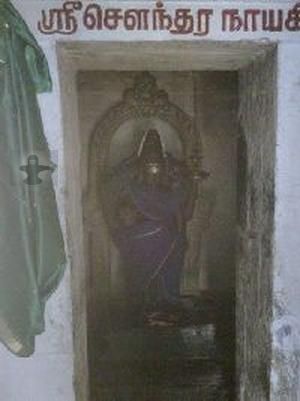
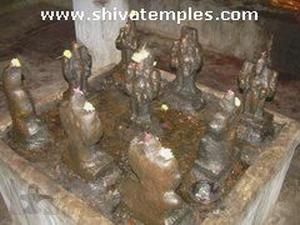
The Rajagopuram of this temple stands majestically, rising three levels into the sky and facing eastward. The intricate stone sculptures adorning the gopuram are remarkably well-preserved despite their venerable age. Passing through the ornate gateway of the gopuram, one enters the outer courtyard of the temple complex. Curiously absent is the flagpole often found in such temples — instead, a solitary altar occupies the space just within the entrance. Circumambulating the perimeter of the courtyard, the devotee encounters subsidiary sannidhis dedicated to the deities Surya and Vinayaka. Further on lies the sannidhi of Subramania with the deity within oriented to the east. The presiding deity of the temple, worshipped as a self-manifested Swayambumurthy, rests upon an elaborately tiered altar in the form of a blooming lotus flower, the lower portion hewn from dark, gleaming stone and the upper part carved from exquisite, translucent jade. The sannidhi of the female deity Soundara Nayaki also faces eastward, the goddess bestowing her blessings upon the faithful in a standing posture. Perhaps the most remarkable and unique feature of this temple lies in its Navagraha shrine, where the nine planetary deities are all precisely positioned facing the central figure of Surya, the sun.
The Goshta Murtha include Dakshinamurthy on the southern side of the wall encircling the inner sanctum. Correspondingly, the western side of this enclosure, where one would customarily find a depiction of Lingodbhava, instead features a representation of Ardhanareeswarar, the androgynous composite form of Shiva and his consort Parvati. A shrine dedicated to Chandeswarar occupies the northern side of the inner prakaram. Flanking the central shrine of Nataraja, the cosmic dancer, are two important figures: on one side stands Vyagrapathar, one of Shiva's foremost devotees, while on the other side sits the legendary sage Patanjali, compiler of the Yoga Sutras and Mahabhashya. Arunagirinathar has extolled the resident Lord Muruga in his hymns collectively known as the Tirupugazh, with Lord Muruga in the company of his two consorts Valli and Deivanai. TiruGyanasambandhar has also composed a pathikam in honour of this temple, which is documented in the second Thirumurai, one of the twelve volumes constituting the Shaivite canon.
Gallery – Vyakra Pureesar Temple, TiruPerumpuliyur