VadaAranyeswarar temple, Tiruvalangadu
Location
Tiru-Valangadu
Deity
Vada-Aranyeswarar, Aalankatteesar, Oorthuvathandava Murthy
Female Deity
Vandarkuzhalammai
Pathikam
Tirunavukarasar-2, Sambandar-1, Sundarar-1
Gallery - VadaAranyeswarar Temple


How to Reach
This Shiva temple is located about 4 km from Tiruvalangadu railway station, on the Chennai–Arakonam section of the Southern Railway. Auto-rickshaws are readily available from the station for easy access to the temple. By road, the temple lies approximately 18 km from Tiruvallur and is conveniently situated near the Tiruvalangadu bus stop on the Tiruvallur–Arakonam bus route, making it easily reachable by public transport.
Temple Address
Thiruvalangadu Post
Near Arakkonam
Tiruttani Taluk
Tiruvallur District
PIN – 631203
Temple Hours
Morning : 6:00 - 20:00
Nearby Paadal Petra Shiva Temples
Temple Overview - The Sacred Rathna Sabha
One of the Five Sabhas
The Vadaranyeshwarar Temple at Tiruvalangadu is revered as Rathna Sabha, one of the Five Sabhas associated with Nataraja, where His cosmic dance is believed to have taken place. This sacred site holds special importance in Saivite tradition as the place where Karaikkal Ammayar was blessed with a divine vision of Nataraja. Devotional lore further holds that she eternally remains at His feet, symbolizing supreme humility and unwavering devotion.
Urdhva Thandavam
The cosmic dance performed at Tiruvalangadu, known as Urdhva Thandavam, is a rare and powerful form in which Nataraja raises His right leg high, close to the right ear, symbolizing supreme ascetic control and transcendence over ego and illusion. The image of Nataraja in this posture is truly awe-inspiring—about four feet tall, endowed with eight arms, and radiating intense dynamism and grace. This unique form sets Tiruvalangadu apart among Nataraja kshetrams and underscores its profound theological and artistic significance in Saivite tradition.
Kali's Submission
The dynamic Urdhva Thandavam of Nataraja is believed to be so supremely powerful that it compelled even the fierce goddess Kali to bow her head in humility, acknowledging Shiva’s transcendental supremacy. In keeping with this sacred legend, a separate sannidhi for Kali is situated directly opposite Nataraja’s sannidhi, accompanied by other attendant deities.
Auspicious Day
According to the Sthala Purana, devotees firmly believe that worshipping Vadaranyeshwarar Temple on the full moon day (Pournami) of the Tamil month Ippasi is especially auspicious. Such a visit is said to bestow great spiritual merit, inner joy, and lasting benefits, making Ippasi Pournami a highly revered occasion for pilgrims to this sacred kshetram.
Temple Layout
The Majestic Entrance
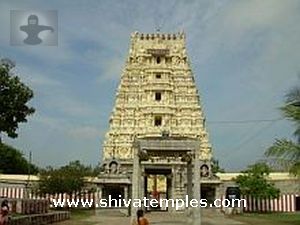
The temple is distinguished by a magnificent five-tiered Rajagopuram facing east, richly adorned with intricate sculptures that add to its imposing grandeur. Flanking the main entrance are the sannidhis of Vallabha Ganapathy and Shree Shanmukha, the latter accompanied by his consorts Valli and Devanai. Together, these shrines create an auspicious and welcoming threshold for devotees entering the temple.
Abisheka Enclosure
Upon passing through the gateway, one immediately notices a pillared enclosure on the right, designated as the sacred space for the Abhisheka ritual dedicated to Nataraja. This specially demarcated area holds great ritual importance, as the abhisheka performed here is considered highly auspicious, underscoring the sanctity and central spiritual role of Nataraja within the temple complex.
Inner Gopuram
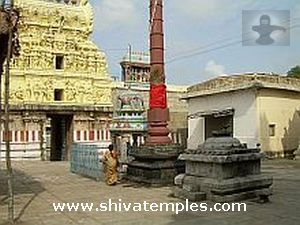
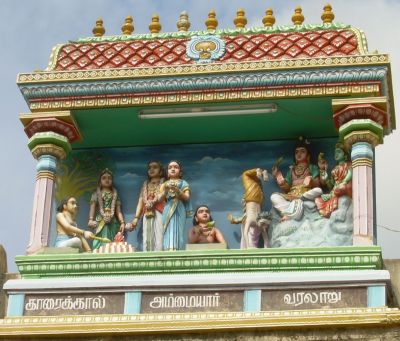
Directly opposite the gateway stand the dwajasthambam, balipeetam, and Nandi, aligned in the traditional axial arrangement. Beyond them rises a three-tiered inner gopuram, richly embellished with intricate carvings that vividly express the temple’s deep cultural and artistic heritage. The walls flanking this inner gopuram are especially evocative, bearing sculptural representations of Karaikkal Ammayar and Meenakshi Sundareswarar. These iconic images seamlessly weave mythology, devotion, and history into the very fabric of the temple’s architecture, enhancing its spiritual and narrative depth.
Female Deity Sannidhi
Passing through the gateway of the inner gopuram, one enters the inner prakaram. To the right is the sannidhi of the female deity Vandar Kuzhali Ammai, gracefully facing south and radiating benevolence and compassion. A notable architectural feature here is the absence of gostha murthas on the outer walls of her sanctum.
Five Sabhas Sculpture
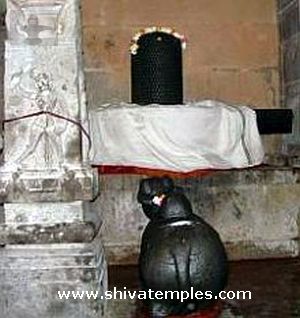
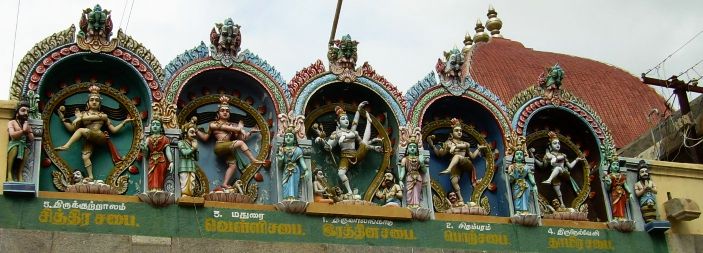
Beyond the inner gateway is the entrance to the sanctum of the presiding deity, where the five Sabhas of Shiva are beautifully depicted as stucco sculptures above the doorway, showcasing the refined imagination and craftsmanship of the temple’s artisans. The presiding deity, Vadaranyeshwarar, is worshipped here in the form of a Shiva Linga, facing east.
Sannidhis in the Prakaram
Other Deities
Encircling the sanctum of the presiding deity, the prakaram accommodates numerous important sannidhis, reflecting the temple’s rich theological breadth. Among these are Surya, Athikara Nandi, and Vijaya Raghava Perumal along with his consorts. Also enshrined here are Shanmukha, Akora Veerabhadra, the Saptha Matha, and the Nalvar—the four great Nayanmars: Appar, Tirugnanasambandhar, Sundarar, and Manikkavasakar. In addition, devotees can worship Karaikkal Ammayar, Karkodaga, Sage Munjikesha, Pathanjali, Anantha, Chandesha Anugrahar, and eight idols of Vinayaka.
Goshta Murthis
The Goshta Murthis adorning the sanctum walls include Vinayaka, Dakshinamurthy, Lingothbhava, Brahma, and Goddess Durga, who is shown accompanied by Durga Parameshwara. In addition to these Goshta murthis, there is a separate sannidhi dedicated to Chandikeshwara.
Pancha Bhootha Lingas
Furthermore, there are Lingas representing the five Shiva temples associated with the five elements of nature. Additionally, there are sannidhis for Sahasra linga, Gajalakshmi, Subrahmanya, and Papahariswara Linga.
Unique Bhairavar
Notably, Bhairavar is seen without his usually accompanied 'Vahana' - the dog, making this depiction unique among Shiva temples.
The Ratna Sabha
The Arudra Abhisheka Mandapam forms the entrance to the sacred Ratna Sabha, whose beauty is further enhanced by a strategically placed mirror that reflects and magnifies the grandeur of the hall. Enshrined within the Ratna Sabha is the Utsava murti of Urdhva Thandava Nataraja, accompanied by Sivakami Amman and Karaikkal Ammaiyar, creating a spiritually inspiring ensemble. The Sabha is also renowned for housing a large Sphatika Linga (crystal lingam) and a smaller Maragatha Linga (emerald lingam), both of which receive ritual Abhishekam four times daily. Along the circumambulatory path stands an image of Chandeshwara, while the Sabha’s Vimana is adorned with copper plating and crowned with five Kalashas.
Tiruvalangadu Inscriptions - A Window to History
The discovery of the renowned Tiruvalangadu Copper Plate Inscriptions revealed an important chapter in the history of Tamil Nadu and the Chola Empire. Consisting of twenty-two copper plates bound together by a large ring bearing the Chola royal seal, these inscriptions are written in both Tamil and Sanskrit and contain valuable historical records relating to the Chola dynasty. The plates provide detailed accounts of the genealogy, achievements, and military successes of the Chola rulers, making them one of the most significant epigraphical discoveries in South India. Today, these priceless artifacts are preserved and displayed in the Government Museum, Chennai, where they serve as a tangible link to the region's glorious past. The inscriptions offer invaluable insights into the political, social, economic, and cultural life of the period, helping historians reconstruct the history and legacy of the Chola dynasty with remarkable detail. Temple Official Website: Click here to visit
Gallery - Temple Features