Vilvavananathar Temple, Tiruvaikavur
Location
Tiruvaikavur
Deity
Vilvavananathar
Female Deity
Sarva Jana Rakshaki, Valaikkai Nayagi
Pathikam
Sambandar - 1
Gallery – Vilvavananathar Temple, Tiruvaikavur

How to Reach
Tiruvaikavur is located on the Kumbakonam–Swamimalai route, approximately 17 kilometres from Kumbakonam. Bus services are available from Kumbakonam to Tiruvaikavur via Swamimalai. The temple can also be accessed from the nearby Paadal Petra Sthalam, Tirupurambiyam, making it convenient to combine both shrines in a single pilgrimage.
Temple Address
Thiruvaikavur
Thiruvaikavur Post
Kumbakonam Taluk
Thanjavur District
PIN – 612301
Temple Hours
Morning : 6:30 - 12:00
Evening : 4:30 - 8:00
Nearby Paadal Petra Shiva Temples
Sthala Puranam
The Hunter’s Salvation on Mahashivaratri
Thiruvaikavur is renowned for its vibrant Mahashivaratri celebrations that attract throngs of devotees each year. According to local legend, this ground bore witness to a divine manifestation, where God Shiva himself appeared before a humble hunter on the auspicious day of Mahashivaratri. The tale unfolds on the verdant banks of the River Kollidam, where a hunter, engrossed in his pursuit, spotted a deer taking refuge in the dense foliage. With unwavering determination, he gave chase, his heart set on capturing his prey. The deer sought sanctuary in the presence of a sage, who was deeply immersed in the worship of a Shivalingam beneath the canopy of a majestic tree in the nearby forest.
The hunter confronted the sage, demanding the release of the deer, and even threatened to take the sage’s life if he stood in the way of his quarry. The sage remained resolute, prepared to defend the innocent deer with his very existence. It was in this pivotal moment that God Shiva, the eternal guardian of his devoted followers, manifested in the awe-inspiring form of a magnificent tiger. The divine feline pursued the hunter, compelling him to seek refuge in the branches of a nearby tree. As the tiger stood sentinel at the base of the tree, the hunter found himself trapped, consumed by fear and hunger through the long hours of the night. He passed the time by methodically plucking leaves from the tree and casting them to the ground below.
That night happened to be Mahashivaratri, and the tree happened to be a vilva tree. The plucked leaves fell upon God Shiva, who stood beneath in the form of a tiger. Throughout the night, the hunter inadvertently performed the ritual of offering vilva leaves, which earned him the ultimate boon of Shivapadam — the state of eternal bliss and liberation from the cycle of birth and death.
Yama Theertham and the Nandi’s Gaze
The next day marked the end of the hunter’s mortal life, and Yama, the god of death, arrived to claim his soul. Nandi failed to notice Yama’s entrance, so Shiva manifested as Dakshinamurthy and drove Yama away. Displeased with Nandi’s lapse in vigilance, Shiva reprimanded him, whereupon Nandi prevented Yama’s escape by holding his breath. Yama sought forgiveness, and Shiva implored Nandi to release him.
As an act of worship, Yama dug a sacred pond near the temple and used its waters to anoint the Shiva Linga, remaining there for several days in devoted worship. This pond came to be known as Yama Theertham, situated directly opposite the main entrance gate of the temple. The Nandi at this temple, unusually, does not face the inner sanctum as is customary; instead, he faces the main gate. According to tradition, this positioning is intentional — to prevent Yama from ever entering again.
Brahma and Vishnu as Dwarapalakas
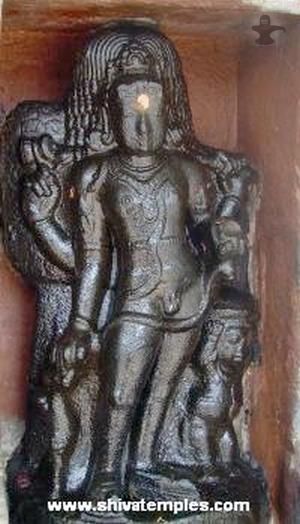
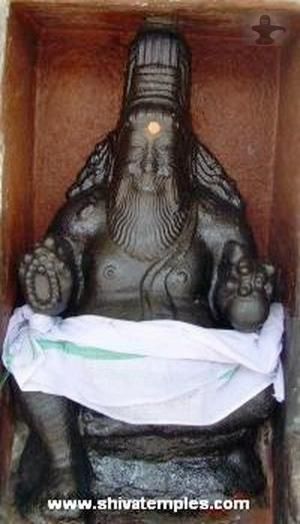
The Sthala Purana recounts the mythological tale behind the unique gate guardians of this temple. Brahma, fearing his divine act of creation would be undone by an impending great flood, constructed a well at this holy site and, after venerating Shiva, humbly took his place as one of the temple’s Dwarapalakas. Mahavishnu came to occupy the role of the second guardian as the result of a curse laid upon him by Salandhiran’s wife, who learned that Mahavishnu had uttered a falsehood with the intention of vanquishing the demon Salandhiran. Having atoned for his transgression, Mahavishnu took up his post alongside Brahma, where he remains to this day performing penance at the temple entrance.
There is another sacred water body here called Agni Theertham, said to have been created by Agni, the god of fire. It is also believed that the sacred Vedas themselves, in the form of vilva trees, are performing penance at this holy site.
Temple Layout
Entrance
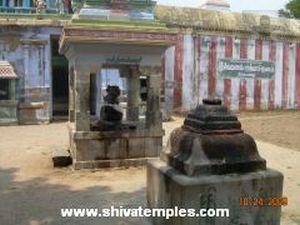
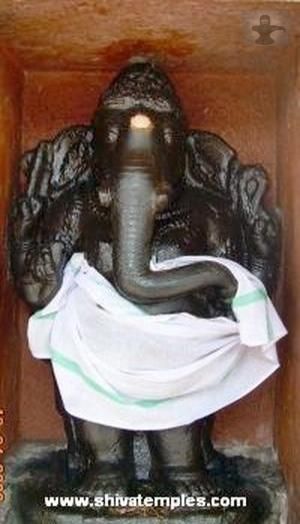
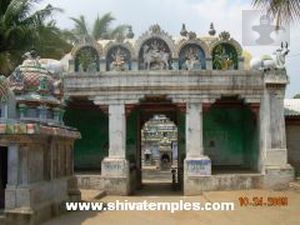
The temple complex is entered through an ornate front gate, above which intricate sculptures adorn the facade, reflecting the skill and devotion of the artisans who crafted them. Directly opposite the gate lies the tranquil Yama Theertham. Proceeding through the gate, devotees find themselves in a spacious courtyard, greeted by the Nandi facing the temple’s entrance. Flanking the courtyard are sannidhis dedicated to the Sapthakanniyar, Vinayaka, and Subramanya accompanied by his consorts Valli and Deivayanai, with his peacock mount looking back gracefully over its shoulder.
The Tower Gate
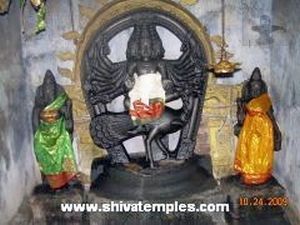
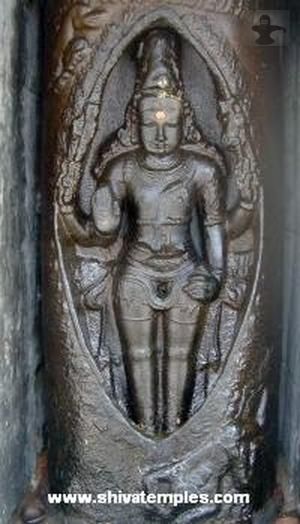
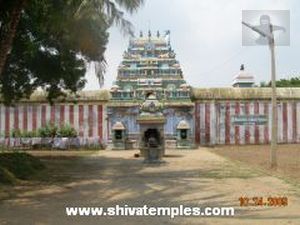
A three-storied tower rises from the far end of the courtyard, surrounded by a sturdy wall. Passing through the tower gate, devotees can trace the story of the hunter’s salvation carved into stone reliefs on the left-hand wall. The Goshta Murtha of Dakshinamoorthy is exquisite for its beauty and rare artistic craftsmanship. Other Goshta Murthas include Lingothbhava, Arthanariswara, and Brahma. Opposite the Goddess Durga stand two idols of Sandeshwarar.
Main Sanctum and Mahamandapam
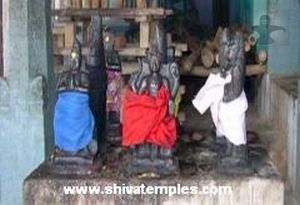
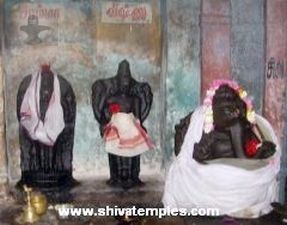
The presiding deity, Vilvavananathar, manifests as a Swayambhu Linga in the east-facing sanctum. To the left, in a separate sanctum, stands the much-revered Goddess, her benevolent gaze fixed toward the rising sun. Along a raised pedestal stands a row of idols — Mahavishnu, Goddess Narayani, Bhairava, Surya, Chandra, and Shani Bhagavan. In the Mahamandapam are the idols of Vinayaka, Brahma, Mahavishnu, and Veena Dakshinamurthy. The temple’s inclusion in the Tevaram is further underscored by Thirugnanasambandhar’s Pathigam extolling the sanctity of Vilvavananathar, found in the third Thirumurai.
More Gallery – Vilvavananathar Temple, Tiruvaikavur