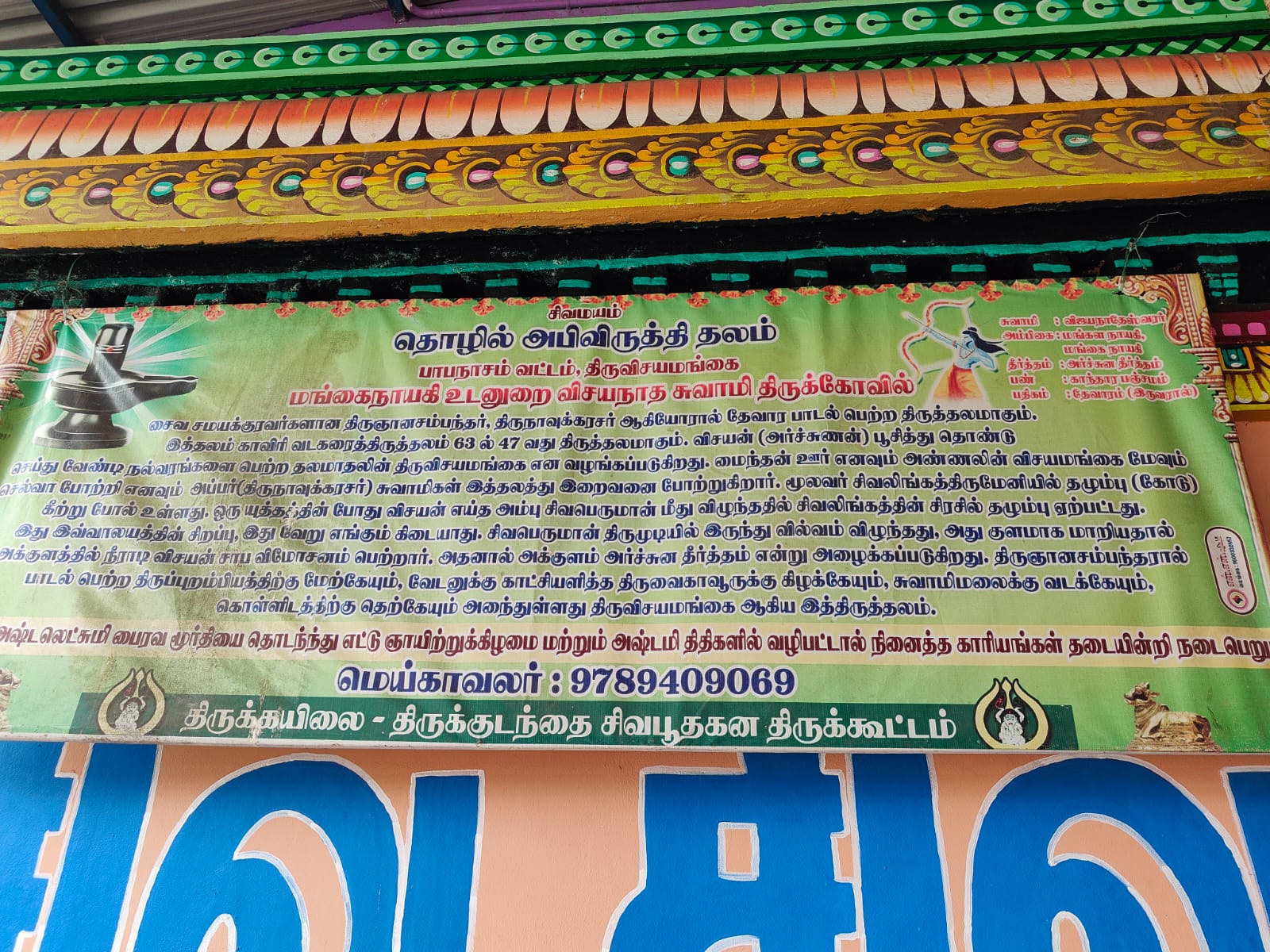
Vijayanathar Temple, Tiruvijayamangai
Location
Tiruvijayamangai (now known as Govindaputhur)
Deity
Vijayanathar
Female Deity
Mangainayaki
Pathikam
Sambandar - 1, Tirunavukkarasar - 1
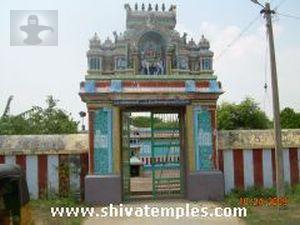
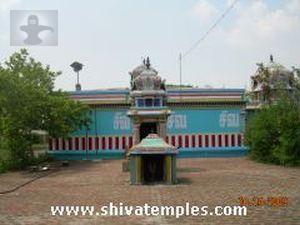
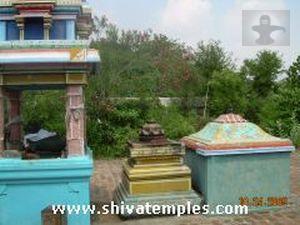
Gallery – Vijayanathar Temple, Tiruvijayamangai
How to Reach
Regular bus services operate from Kumbakonam to Tiruvijayamangai. Visitors may alight at Govindaputhur, from where the temple is located within a short walking distance. Pilgrims can also conveniently visit the nearby Paadal Petra Sthalam, Tiruvaikavur. Alternatively, Tiruvijayamangai can be reached via Tirupurambiyam, making it easily accessible from multiple routes..
Temple Address
Thiruvisayamangai
Pullabhoothangudi Post
Kumbakonam Taluk
Thanjavur District
PIN – 612301
Temple Hours
Morning : 8:00 - 12:00
Evening : 5:00 - 7:00
Contact
Chandrasekara Gurukkal
8825811973, 9448380910
Nearby Paadal Petra Shiva Temples
Sthala Puranam
Arjuna and the Pasupadastra
Thiruvijayamangai is revered as the place where Arjuna performed intense penance to obtain the powerful Pasupatastra from Shiva. According to the Mahabharata, Arjuna sought this divine weapon to aid the Pandavas in their forthcoming battle against the Kauravas. Following the counsel of Krishna, he came to Thiruvijayamangai and undertook rigorous austerities and deep meditation, seeking to earn Shiva’s grace and demonstrate his worthiness to receive the celestial weapon.
However, his penance was soon disrupted by the arrival of Mukasura, a demon dispatched by the envious Duryodhana in the form of a wild boar. God Shiva, accompanied by his consort Parvati, manifested as a hunter and swiftly slew the boar, with the four Vedas themselves transforming into loyal hunting dogs at his side. Simultaneously, Arjuna loosed an arrow at the same boar, leading to a heated dispute between Arjuna and the disguised hunter over who could rightfully claim the kill.
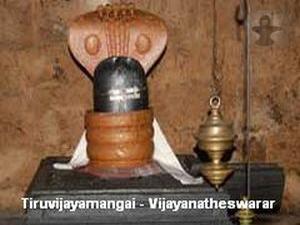
As tempers flared, Arjuna’s bow shattered in the ensuing scuffle, prompting the enraged warrior to strike the hunter with the broken weapon — a blow so powerful that its reverberations were felt across all three worlds. In that pivotal moment, God Shiva revealed his true divine form to Arjuna, bestowing upon him the coveted Pasupadastra before vanishing from sight. Thus, the temple earned the name Thiruvijayamangai, immortalizing the site where Arjuna (Vijaya) received the blessings and favour of Shiva. To this day, devotees and pilgrims visiting the temple can bear witness to the enduring mark left by Arjuna’s bow upon the sacred Shiva lingam, a tangible reminder of this legendary encounter.
Origin of the Name Govindaputtur
The name Govindaputtur holds a fascinating origin story. According to local tradition, a devoted cow (Go in Tamil) once worshipped the Linga by reverently pouring milk from its own udders onto the Linga. Thus, the place came to be known as Govantaputtur, forever immortalizing the cow’s profound display of piety. In his Pathigam, TiruNavukkarasar explicitly mentions both the town’s name, Govindaputtur, and the temple’s name, Vijayamangai, in the third song of his composition.
Temple Layout
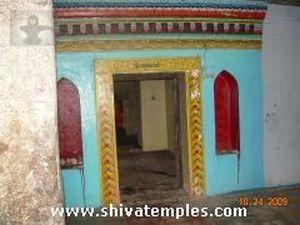
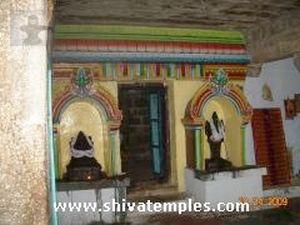
The Vijayanatheswarar Temple exhibits a unique architectural design that deviates from the typical tower-adorned temples commonly found in the region. Instead, the temple features a walled entrance gate, above which a striking sculpture depicting the divine couple Shiva and Parvati seated upon a bull can be observed. Upon passing through this ornate threshold, visitors encounter a small shrine housing Lord Vinayaka, followed by an altar and a Nandi Mandapam situated behind the deity.
Main Sanctum
The main sanctum holds the Swayambhu Linga of Vijayanatheswarar on a square aavudayar or pedestal, facing eastward, while the sannidhi of Ambal Mangainayaki is oriented southward. Notably, the four-armed form of Mangala Nayaki assumes a benevolent stance, with her front hands displaying the Abhaya Mudra, a gesture of fearlessness and protection, while one hand grasps an Akshara Mala, a sacred rosary, and the other delicately holds a Nilotbhava, the blue water lily, symbolizing divine beauty and purity.
Other Shrines
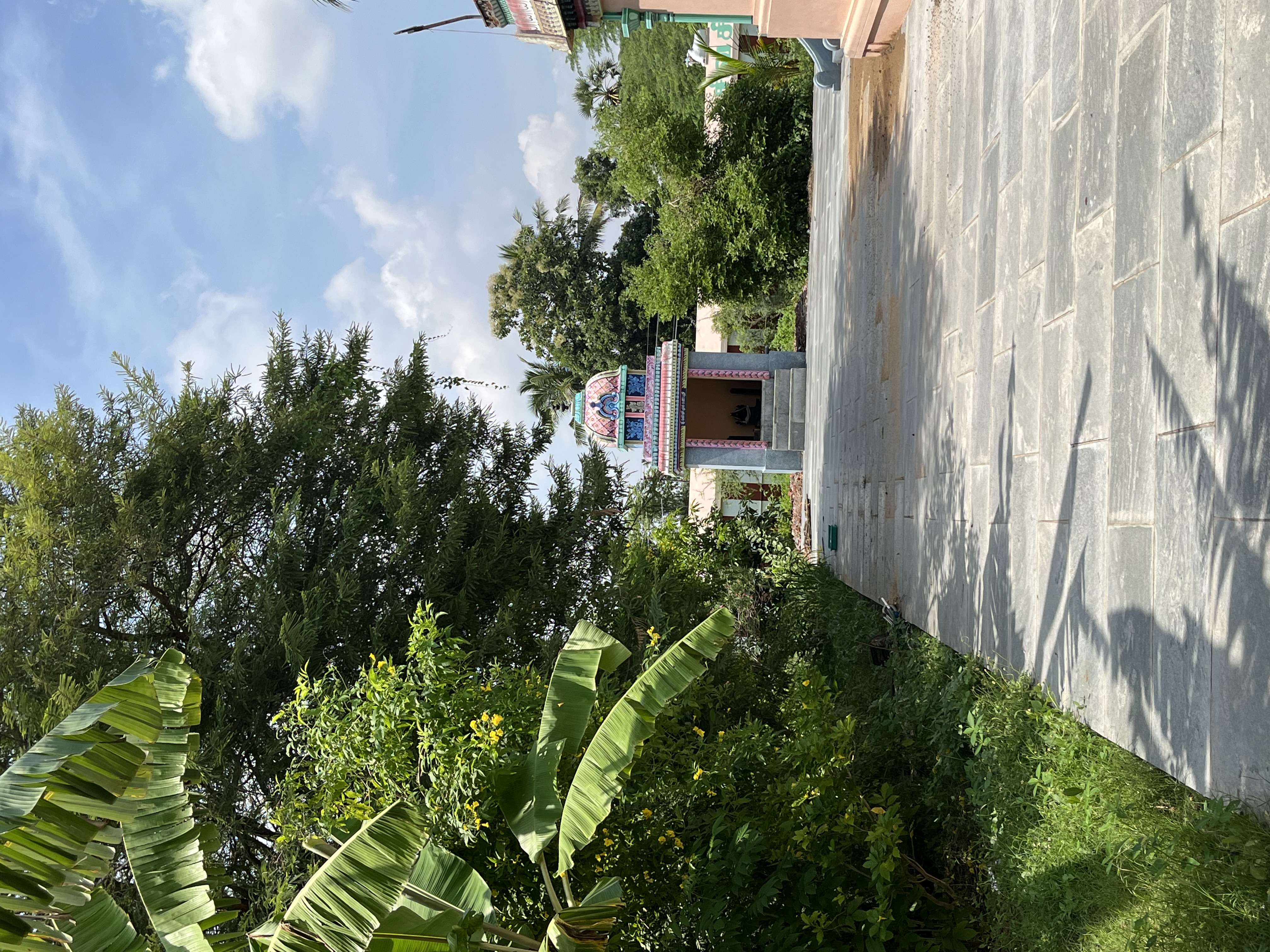
Encircling the main temple structure, one finds separate sannidhis dedicated to Narthana Vinayaka, Anugraha Dakshinamoorthy, Surya, and Chandran, and for the primary four Nayanmars. The temple is renowned for its two Pathigams, or hymns of praise, composed by the revered Tamil saint-poets Thirunavukkarasar and TiruGyanasambandhar.
Gallery – Vijayanathar Temple, Tiruvijayamangai