Ayavantheeswarar temple, TiruSaathamangai
Location
TiruSaathamangai (Now kown as Seeyathamangai)
Deity
Ayavantheeswarar
Female Deity
Ubaya-Pushpa-Vilochani
Pathikam
Sambandar - 1
Ayavantheeswarar Temple Photos

How to Reach
This Shiva temple is situated on the Nannilam–Tiru-Pugalur road, close to the Tirumarugal–Nagore road. After crossing Tirumarugal, travel about 1 km towards Nagore until you reach a guide stone marked "Koil Seeyathamangai". From there, the temple is another kilometre away. The temple is located about 8 km from Tiru-Pugalur.
From Nagapattinam, It is situated about 13 km on the Nagapattinam–Nagore–Kumbakonam road. Seeyathamangai lies off the main road, between Nagapattinam and Sannanallur. The village is traditionally known as Saathamangai, while the temple itself is called Ayavanthi.
Temple Address
Seeyathamangai
Seeyathamangai Post
Nannilam Taluk
Tiruvarur District
PIN – 609702
Temple Hours
Morning : 8:00 - 12:00
Evening : 5:30 - 7:30
Nearby Paadal Petra Shiva Temples
Temple Layout & Shrines
Vaippu Sthalam
Tiru-Saathamangai, now popularly known as Seeyathamangai, is a Paadal Petra Sthalam glorified in the Thevaram hymns of Tiru-gnanasambandhar. The temple is also revered as a Vaippu Sthalam, having been mentioned by Appar in his hymns on Tiruvathigai Veerattanam (6-7-10) and the Kshethra Kovai Thiruthandagam (6-70-9), where he refers to this place by the names Ayoganthi and Ashoganthi.
Temple Layout
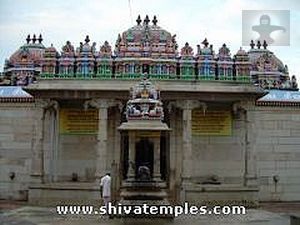
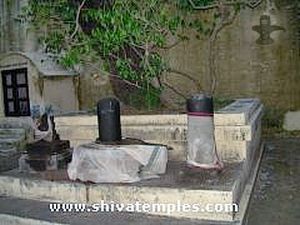
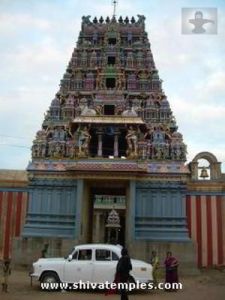
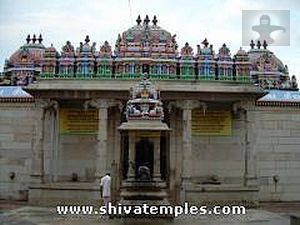
Today, this place is known as Seeyathamangai, though it was traditionally called Saathamangai, while the temple itself is known as Ayavanthi. Surrounded by lofty outer walls, this spacious temple is unique in having separate sannidhis for the presiding deity and the Goddess, each with its own entrance and gopuram, both facing west. Opposite the main entrance stands the temple tank, whose two sections are revered as Chandra Theertham and Surya Theertham. A sannidhi dedicated to Siddhi Vinayaka is situated on its bank. The majestic five-tiered rajagopuram opens into a vast courtyard, from where devotees can circumambulate the outer prakaram. Along the prakaram are sannidhis for Chandra, Saneeswarar depicted with one foot resting on a crow, the Saptha Mathas, Bhairavar, the Navagrahas, Mahalingam, Viswanathar, Visalakshi, Vinayaka and several other deities. The temple's sacred Konrai tree also shelters Shiva Lingams and a sannidhi for Vinayaka, adding to the spiritual significance of the prakaram.
Shrines in the Inner Prakaram
Passing through the inner entrance into the front mandapam and proceeding clockwise, devotees first come across the sannidhis of Muruga with Valli and Deivanai, Mahalakshmi, and the Primary four Nayanmars. Nearby are the idols of Tiru Neelanakka Nayanar, one of the 63 Nayanmars, along with his wife. After worshipping Somaskandar and Mahaganapathi, one can ascend the steps to the inner prakaram, where the utsava idols of Neelanakka Nayanar, his wife, and Natanasundarar are enshrined. In the Nataraja Sabha, Lord Nataraja appears with Goddess Sivakami and Manickavasagar. Saneeswarar is depicted standing with one foot resting upon a crow.
Sanctum of the Presiding Deity
In the west-facing sanctum, the presiding deity Ayavantheeswarar graces devotees as a swayambhu (self-manifested) Lingam. The Lingam bears blister-like formations over its entire surface, a unique feature that is closely associated with the legend of Tiru Neelanakka Nayanar. Among the Goshta deities, the exquisitely sculpted idol of Dakshinamurthy stands out for its artistic beauty. Equally captivating is the remarkable sculpture of Gowri Leelai on the outer wall of the sanctum, positioned between Narthana Ganapathi and Sage Agasthiyar, which is a fine example of the temple's exceptional craftsmanship.
Pillar Sculptures
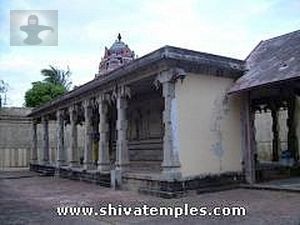
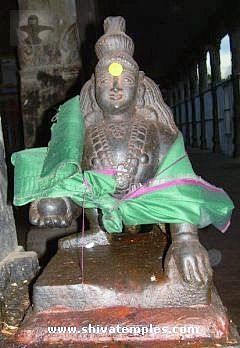
One of the pillars in the outer mandapam features an attractive sculpture of Hanuman with a bell tied to his tail. Nearby, another pillar bears a delightful image of the crawling child Krishna.
Goddess Shrine
The sannidhi of the Goddess stands as a separate temple complex and houses sannidhis for Surya, Vinayaka and Subramanya. The Nandi here is installed on a raised platform. After ascending the steps leading to the sanctum, devotees are welcomed by Vinayakar, seated on His Mooshika vahana, and Dandapani, who serve as the guardian deities at the entrance. Inside the sanctum, the Goddess stands in a graceful posture with four arms, showering Her divine blessings upon devotees.
Sthala Puranam
The Legend of Tiru Neelanakka Nayanar
Tiru-Sattamangai is the birthplace of Tiru Neelanakka Nayanar, one of the revered 63 Nayanmars. Idols of the saint and his devoted wife can be seen in the temple's maha mandapam. Every day, Tiru Neelanakka Nayanar and his wife, Mangayarkkarasiyar, lovingly worshipped Ayavantheeswarar with offerings of 'Konrai' flowers. On one such occasion, while they were worshipping in the sanctum, Mangayarkkarasiyar noticed a spider on the Shiva Lingam. Fearing that it might harm the Lord, she instinctively blew it away with her breath. Neelanakka Nayanar, believing that her saliva might have fallen upon the sacred Lingam, regarded the act as irreverent and was deeply distressed. Unable to accept what he considered an improper act, he separated from his wife and began living apart from her.
That night, God Shiva appeared in Neelanakka Nayanar's dream and revealed the true greatness of his wife's devotion. The Lord showed him that the entire surface of the Lingam had become covered with blister-like marks, except for the spot where Mangayarkkarasiyar had blown away the spider. Through this divine vision, He made Neelanakka Nayanar realise that her action had not been an act of irreverence, but one born of pure love and sincere devotion. At daybreak, Neelanakka Nayanar hurried to the temple and was overwhelmed with emotion on seeing the Deity exactly as He had appeared in his dream. His heart filled with joy on realising that the Lord Himself had borne witness to his wife's devotion and had spoken in her praise. Filled with remorse and gratitude, he joyfully reunited with Mangayarkkarasiyar, and together they resumed their devoted service to Lord Ayavantheeswarar.
Tiru-gnanasambandhar's Visit
After Tiru-Nallaru, Tiru-gnanasambandhar arrived at Tiru-Sattamangai. Tiru Neelanakka Nayanar, having beautifully adorned the town in anticipation of the saint's arrival, received him with great reverence and honour. Together they proceeded to the Ayavanthi Temple, where they worshipped Ayavantheeswarar before returning to Neelanakka Nayanar's home. There, Sambandhar partook of a sacred meal and stayed for the night. The following morning, he returned to the temple and sang a Thevaram decade in praise of the deity. In both the second verse and the concluding verse of this hymn, he pays special tribute to Tiru Neelanakka Nayanar. This sacred hymn is included in the Third Thirumurai.
Significance of the Thevaram Hymn
In his hymn, Tiru-gnanasambandhar glorifies Tiru-Sattamangai in many beautiful ways. He describes it as a place adorned with fragrant flower gardens where lofty trees seem to brush against the clouds, as groves filled with sweet-scented blossoms that bloom throughout the year, and as a land of verdant orchards rising so high that they appear to touch the cool white moon. He also praises the temple of Ayavanthi, where Tiru Neelanakka Nayanar worshipped with unwavering devotion, and celebrates Tiru-Sattamangai as the saint's birthplace, revered by devotees through the ages.
Ayavantheeswarar Temple Photos