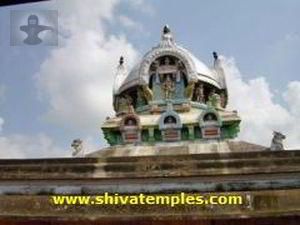
Nethrarpaneswarar temple, Tiru-Veezhi-Mizhalai
Location
Tiru-Veezhi-Mizhalai
Deity
Nethrarpaneswarar
Female Deity
Bruhat-Sundara-Kuchambikai
Pathikam
Tirunavukarasar - 8, Sambandar - 14, Sundarar - 1
Gallery – Nethrarpaneswarar Temple, Tiruveezhimizhalai


How to Reach
From Kumbakonam, take the road towards Thiruvarur up to Natchiyar Koil. From there, follow the Natchiyar Koil–Poonthottam road to reach Thenkarai. From Thenkarai, cross the Arasalaru River to the north and travel 1 km to reach Tiruveezhimizhalai Temple. Those coming from Chennai or Puducherry can travel up to Mayiladuthurai (Mayavaram) and then take the Mayiladuthurai–Thiruvarur road up to Poonthottam. From Poonthottam, proceed via the Poonthottam–Natchiyar Koil road to reach Thenkarai, and continue onwards to the temple. The temple is situated about 10 km from Poonthottam, on the northern bank of the Arasalaru River.
Temple Address
Thiruveezhimizhalai
Thiruveezhimizhalai Post
Kudavasal Taluk
Tiruvarur District
PIN – 609505
Temple Hours
Morning : 8:00 - 12:00
Evening : 5:00 - 8:00
Nearby Paadal Petra Shiva Temples
Sthala Purana
The Significance
Many temples have been glorified in the hymns of the triad — three revered Tevaram saints. Among them is Thiruveezhimizhalai, which holds a special place with as many as 23 pathigams (decadal hymns) dedicated to it. The name Thiruveezhimizhalai is believed to have originated from the abundance of Veezhi plants that once flourished in this region. The sacred tree (Sthala Vriksham) of this temple is also the Veezhi tree.
Mahavishnu's Worship
According to various Puranic accounts, when the Sudarshana Chakra (divine discus) of Mahavishnu lost its power, he worshipped Shiva to regain a powerful weapon. The Sthala Puranas of temples such as Tirumarperu, Thiruppaigneeli, and Thiruveezhimizhalai narrate this episode of Vishnu worshipping Shiva. Among these, Thiruveezhimizhalai is regarded as especially significant. It is said that Mahavishnu needed a divine discus to destroy the demon Jalandhara. To obtain it, he came to Thiruveezhimizhalai to pray to Shiva. He learned that by offering worship with one thousand lotus flowers, his wish would be fulfilled. Accordingly, he gathered a thousand lotuses and began the ritual. However, after offering 999 flowers, he realized that one flower was missing. Determined to complete the worship without any deficiency, Vishnu — whose eyes are often compared to lotus — plucked out one of his own eyes and offered it in place of the final lotus. Deeply moved by this supreme act of devotion, Shiva appeared before him and granted him the powerful Sudarshana Chakra as desired. Thus, Thiruveezhimizhalai is revered as the sacred place where Mahavishnu offered his own eye in devotion to Shiva.
Mizhalai Kurumbar
This place was once a dense forest filled with Veezhi shrubs, sandalwood trees, champak trees, jackfruit trees, and wood apple trees. A hunter known as Mizhalai Kurumbar lived here. Every day, he worshipped Veezhinathar by offering a vilangani (wood apple fruit) as naivedyam. Pleased with his sincere devotion, Shiva appeared before him and bestowed his blessings. Thereafter, Mizhalai Kurumbar adopted an ascetic life, performed intense penance, and attained the Ashta Siddhis (eight mystical powers). In recognition of his devotion, a separate sannidhi has been dedicated to Mizhalai Kurumbar in this temple.
Legend of Swethaketu
Swethaketu, the son of a king, was foretold by astrologers to face death at the age of sixteen. Distressed by this prediction, the king sought the guidance of sages, who advised that by visiting Thiruveezhimizhalai and performing sincere worship to the residing deity Shiva, the fate of untimely death (Kala Mrityu) could be overcome. Following their advice, Swethaketu came to Thiruveezhimizhalai and began to worship the deity with deep devotion every day. When the destined moment of his death approached, Yama, the god of death, cast his noose (paasa kayiru), which encircled not only Swethaketu but also the Shiva Lingam he was worshipping. At that instant, Shiva emerged from the Lingam and, just as He had once protected Markandeya, struck down Yama with His foot and saved Swethaketu from death. Later, at the request of the Devas, Shiva revived Yama but commanded that he should never approach or claim the lives of His devotees while they are engaged in ShivaPuja.
The Layout
Gopuram and Sannidhis
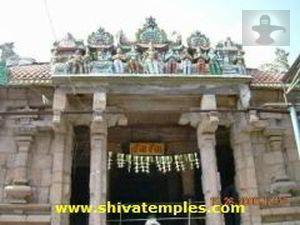
In front of the east-facing five-tiered Raja Gopuram, there is a large and beautiful temple tank. The sanctum of the presiding deity, Nethrarpaneswarar (Eeswarar), also faces east. The Moolavar appears in a self-manifested (Swayambhu) form, standing at a height of about 5 feet, bestowing His grace to the devotees. On the rear wall of the sanctum, behind the Shiva Lingam, are the sacred images of Parvati and Parameswara. As this is the place where Shiva married Goddess Uma, symbolic elements of a wedding are present — there is a pillar known as the Arasaṇikkāl at the entrance of the sanctum, and another called the Panthakkāl in the outer Maha Mandapam. In the Maha Mandapam, Kalyanasundarar appears as the divine bridegroom (Maappillai Swami) and serves as the Utsava Murti of this temple. Notably, above his right foot can be seen the symbolic eye offered by MahaVishnu, and below it, the Sudarshana Chakra. Bhikshatana, Rathi Devi, Vasishta, Kamadhenu, and Manu have offered their worship to the presiding deity Nethrarpaneswarar.
Vinnizhi Vimana
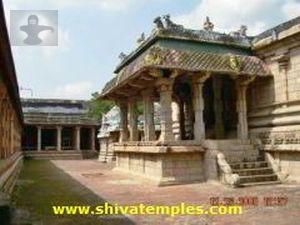
More than the main entrance tower (Gopuram), the Vimana above the sanctum (Garbhagriha) stands out as a unique architectural highlight of this temple. This Vimana, supported by sixteen sculpted lions, is known as the "Vinnizhi Vimanam." According to legend, after receiving the Sudarshana Chakra, MahaVishnu brought this Vimana from Vaikuntha and adorned the temple with it. In the temple's first Prakaram, the hundred-pillared hall (Noorrukkal Mandapam) is a fine example of exquisite stone craftsmanship. In a chamber to the right of the sanctum, MahaVishnu can be seen in a rare posture, worshipping with one of his eyes offered in devotion. The sannidhi of the Goddess, Sundara Kuchambal, is situated close to the sanctum of the presiding deity, completing the sacred layout of this revered temple.
Architectural Marvel — Vavval Nethi Mandapam
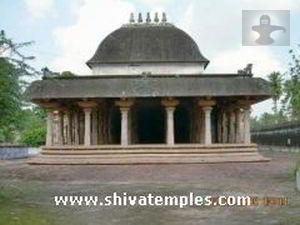
The Vavval Nethi Mandapam in this temple is renowned for its exceptional craftsmanship and stands as a rare architectural marvel. The name itself comes from its distinctive design — the curved roof resembles the forehead of a bat ("Vavval" means bat and "Nethi" means forehead in Tamil). This unique style is traditionally associated with the Chola, Vijayanagara, and Maratha periods. In fact, temple architects (sthapathis) of earlier times would agree to undertake renovation works only on the condition that rare masterpieces such as the Vavval Nethi Mandapam of Tiruveezhimizhalai and the stone lattice (Kal Palagani) of Tiruvalanchuzhi were excluded — highlighting the complexity and excellence of these structures. Located to the right immediately after entering through the Raja Gopuram, this mandapam is remarkable for its wide, open layout without any central pillars. Its arched, dome-like roof — constructed using lime mortar — demonstrates extraordinary engineering skill, allowing for a spacious interior without structural supports. Another fascinating feature is that the design prevents bats from inhabiting the ceiling, adding to its uniqueness. During the Tamil month of Chithirai, it serves as the sacred venue for the grand celestial wedding (Thirukalyanam) of Parvati and Parameshwarar, making it not only an architectural wonder but also a vibrant centre of temple festivities.
Pathikam
This sacred temple holds the distinguished honour of being praised in the Tevaram hymns by all three revered saints — Tirunavukkarasar (8 pathigams), Tirugnanasambandar (14 pathigams), and Sundarar (1 pathigam).
Divine Coins
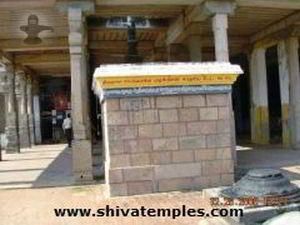
Both Tirunavukkarasar (Appar) and Tirugyanasambandar visited this temple together at a time when the region was suffering from a severe famine, and people were struggling without food. Under such difficult circumstances, it became challenging for the two saints to provide meals for the devotees who had accompanied them. They went to the temple, worshipped Shiva, and sang pathigams in devotion. The next morning, they found a coin (padikkaasu) placed on the eastern Bali Peetam and another on the western Bali Peetam. Using these divine offerings, they fed the devotees. This miracle continued daily, with the divine providing coins until the famine in the land came to an end. Interestingly, while granting these coins, Appar received good-quality coins, but Sambandar received coins of lesser value. Observing this, Sambandar sang the hymn beginning with "Vaasi Theerave Kaasu Nalkuveer", after which Sambandar too was blessed with proper coins. Even today, the Bali Peetams where these coins were divinely placed can be seen on the eastern and western sides of the temple. Near the western Bali Peetam is the sannidhi of Padikkaasu Pillaiyar, along with the idols of Appar and Sambandar. The monasteries (Thirumadams) where the two saints stayed are located on the northern street — Sambandar's at the eastern end and Appar's at the western end.
Gallery