Meenakshi Sundareswarar Temple, TiruAalavoi (Madurai)
Location
Madurai
Deity
Sundareswarar, Somasundarar, Sokkanathar
Female Deity
Meenakshi
Pathikam
Tirunavukarasar - 2, Sambandar - 9
Gallery - Meenakshi Temple


How to Reach
The temple is centrally located in Madurai. The city is well connected by road, rail, and air, making it easily accessible from major parts of Tamil Nadu and other regions of India.
Temple Address
Madurai
Madurai District
PIN – 625001
Temple Hours
Morning : 5:00 - 12:30
Evening : 4:00 - 9:30
Nearby Paadal Petra Shiva Temples
Nearby Divya Desams
Specialities
Shakthi Peetam: Manthrini
Pancha Sabha: Silver
Pooja: Palli-Arai or Artha-Jama Pooja
Important Information for Visitors
- Located at the heart of the city, the Meenakshi Sundareshwarar Temple forms the very center around which Madurai is built. Most of the roads leading to the temple are designated as one-way routes, and parking for four-wheelers is restricted along these stretches. Visitors can, however, make use of the multi-level car parking facility situated near the East Tower. From there, it is just a short walk to the South Tower, which serves as the main entrance to the temple.
- The temple maintains a strict ban on the use of electronic devices within its premises. All such items must be deposited at the kiosk located near the entrance of the South Tower before entering. During peak seasons, visitors may also be restricted from carrying handbags inside the temple for security reasons.
- The temple attracts a large number of visitors, often leading to long queues and extended waiting times.
- It may take several hours to complete the darshan of Goddess Meenakshi and Lord Sundareshwarar and exit the temple premises. Visitors are advised to allocate at least half a day to fully explore this vast and magnificent temple complex.
Seasonal Note
During the Tamil month of Margazhi, the temple’s outer tower gates are opened as early as 3:30 a.m. The temple remains open until 12:00 noon, after the Uchikala Pooja (midday worship). It reopens at 4:00 p.m., and the Palliarai Pooja (night ceremony) is performed at 9:00 p.m. All rituals conclude by 9:30 p.m., after which the temple gates are closed for the day.Temple History and Legends
Introduction
The Meenakshi Sundareswarar Temple, located in Madurai, Tamil Nadu, is renowned as one of the most magnificent temples in South India and holds immense religious and cultural significance. The city itself is known by many names, each reflecting its rich heritage and timeless devotion.
Origin of the Name 'Madurai'
The etymology of the name Madurai is rooted in a divine legend. It is said that God Shiva once cleansed snake venom with the nectar (madhu) of the crescent moon adorning His hair. In ancient times, the area was a dense forest filled with Kadamba trees. A merchant named Dhananjayan discovered a Shiva Linga within this forest and informed King Kula Sekhara Pandiyan. The king cleared the forest, built a temple around the sacred Linga, and the city gradually developed around it. During the discovery, sweet nectar was seen dripping from the tree above the Linga — an occurrence that inspired the city’s name, Madurai, meaning “the city of nectar.”
The Name 'Aalavai'
The city was also known as Aalavai, a name derived from a unique legend. It is said that Shiva’s serpent encircled itself with its tail in its mouth, forming a protective boundary around the city — symbolizing divine safeguarding and completeness.
Nan-Mada-Koodal
Madurai, also known as Naanmada Koodal, owes its name to another fascinating legend, when Varuna, the god of rain, released seven clouds to inundate the city, Shiva released four clouds from His matted locks to protect Madurai from the deluge. The term Naanmada Koodal translates to “the junction of four towers,” also symbolizing the four major temples for which ancient Madurai was celebrated.
Shakti Peetam
The temple is recognized as one of the sixty-four Shakti Peetams. Within its sacred precincts, it is customary for devotees to first offer their prayers to Goddess Meenakshi before proceeding to worship Sundareswarar.
Temple Architecture
Temple Dimensions
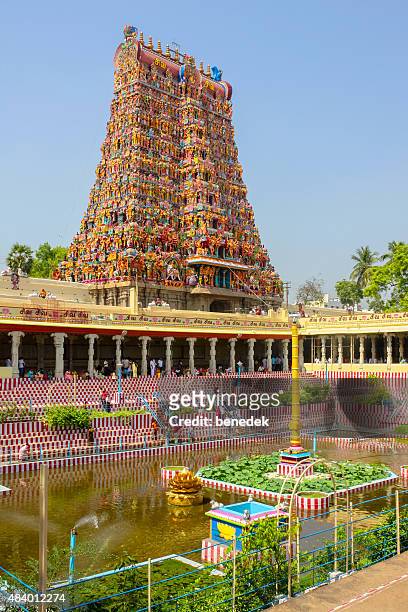
The temple complex covers an area of about 17 acres, extending 847 feet from east to west and 792 feet from north to south. It features eight majestic gopurams (towers) and two vimanams. The South Gopuram, rising to a height of 160 feet, is the tallest among them, followed by the East Gopuram, which stands at 153 feet. All the gopurams, except the northern one, are adorned with exquisite and vividly colored sculptures depicting various deities and mythological scenes.
Ashtasakthi Mandap and Goddess Meenakshi
The Ashta Shakthi Mandapam is located opposite the sanctum of Goddess Meenakshi Amman. At its entrance stands a captivating sculpture depicting the divine wedding of Meenakshi and Sundareshwarar, flanked by the figures of Vinayaka and Muruga. Inside the mandapam, the pillars are beautifully carved to represent the eight manifestations of Shakti. The idol of Goddess Meenakshi, crafted from emerald, radiates an indescribable charm. She holds a parrot in one of her hands and is venerated by many names, including Maragathavalli, Thadathagai, Komalavalli, Pandiarajakumari, Manickavalli, and Sundaravalli. Her eyes are compared to those of a fish, symbolizing her nurturing grace — just as a fish is believed to hatch its eggs through the warmth of its gaze, Goddess Meenakshi is said to protect her devotees with her compassionate vision.
The Presiding Deity - Sundareswarar
The presiding deity, Sundareswarar, is revered as the Moola Lingam (the primordial Shiva Lingam). This sacred Lingam is believed to have manifested even before those in other renowned holy sites such as Merumalai, Vellimalai, Thirukedaram, and Varanasi, making it one of the earliest and most venerated forms of Lord Shiva.
Mukkuruni Vinayaka
Thirumalai Naicker, who ruled Madurai from 1623 to 1659 A.D., discovered this idol of Vinayaka while excavating land for the construction of his palace. The large idol, standing seven feet tall, was later consecrated in the temple in 1645 A.D. A traditional custom continues to this day, wherein a grand offering of Kozhukattai (sweet rice dumplings) is made to this Vinayaka on every Vinayaka Chaturthi, using 18 Mukkuruni (a traditional measure of rice).
Temple Specialties
Kambathadi Mandapam
The Kambathadi Mandapam, situated opposite the main sanctum, is adorned with a wealth of exquisite sculptures. At its center stand the gold-plated Dwajasthambam (flagstaff), Nandi, and Balipeetam. The mandapam features eight beautifully carved pillars, each intricately embellished with magnificent sculptures that capture the essence of divine artistry. Among these are captivating depictions of Sankaranarayana, Somaskanda, Ardhanareeswarar, and the Dasavataras of Lord Vishnu — each a masterpiece of craftsmanship. Yet, it is the sculpture of Meenakshi and Sundareswarar that truly commands attention, representing the pinnacle of artistic excellence within the mandapam. Adding to the grandeur are the striking sculptures of Agni Veerabhadra and Agora Veerabhadra on two prominent pillars near the Kambathadi Mandapam, along with the impressive idols of Urthuva Thandavar and Kali on the adjoining pillars — all radiating a divine charm that leaves every visitor spellbound.
Budhan Parikaram
The presiding deity, Lord Sundareswarar, also known as Chokkanathar, is associated with Budhan (the planetary deity corresponding to Mercury). Hence, it is customary for devotees to perform pariharam (remedial offerings) for Budhan at this temple.
Indra's Victory
According to legend, Indra, after vanquishing the demon Vridhasuran, sought absolution for the Brahmahathi Dosha that followed his act of slaying. To atone, he worshipped the Shivalingam in Kadambavanam. In commemoration of his victory and redemption, he is said to have constructed a magnificent vimanam, adorned with 32 lions, 64 Shiva Ganas, and eight white elephants that appear to uphold the sacred structure.
Land of festivals
Chitra pournami
Madurai is a city that celebrates festivals all through the year, with the Chithirai Pournami festival standing out as the grandest of them all.
Tiruvilayadal
The city of Madurai is the sacred setting for all 64 Tiruvilayadals — the divine plays of Shiva. These celestial events are artistically depicted along the prakaram surrounding the Swamy Sannidhi. The temple’s Sthala Vruksham (sacred tree) is the Kadamba tree, while its holy waters (Theertham) are the Potramarai Tank and the Vaigai River. A Crystal Lingam, discovered centuries ago in the Potramarai Tank, continues to be revered and worshipped at the Madurai Aadheenam.
Ayiramkal Mandapam - Hall of Thousand Pillars
The Ayiramkal Mandapam, also known as the Hall of a Thousand Pillars, is the largest mandapam within the temple complex, featuring 985 intricately carved pillars arranged symmetrically in all directions. At the center of the mandapam stands the idol of Lord Nataraja, representing the Silver Sabha (Velliambalam), one of the five sacred Pancha Sabhas where Lord Shiva is believed to have performed His cosmic dance. Unlike in most temples where Nataraja is depicted with His left leg raised, here He is portrayed with His right leg lifted, a unique and striking depiction. The mandapam is further adorned with a breathtaking collection of sculptures, each a masterpiece that captivates every visitor with its intricate detail and divine beauty.