Arunachaleswarar Temple, Tiruvannamalai
Location
Tiruvannamalai
Deity
Arunachaleswarar, Annamalayar
Female Deity
Unnamalai
Pathikam
Tirunavukarasar - 3, Sambandar - 2
Gallery - Arunachaleswarar Temple


How to Reach
Tiruvannamalai is a well-connected town, easily accessible by both road and rail. Frequent bus services operate from Chennai via Chengalpattu – Madurantakam – Tindivanam – Gingee, and also through Sriperumbudur – Kanchipuram – Vellore – Polur. The town is located 90 km from Vellore, 60 km from Tindivanam, 60 km from Villupuram, and 100 km from Krishnagiri. Tiruvannamalai is also connected by rail from Chennai and other major towns in Tamil Nadu. The Tiruvannamalai Railway Station lies on the Villupuram–Katpadi section of the Southern Railway.
Temple Address
Tiruvannamalai
Tiruvannamalai District
PIN – 606601
Temple Hours
Morning : 5:30 - 12:30
Evening : 4:00 - 9:30
Nearby Paadal Petra Shiva Temples
Spiritual Significance
"Dārśanāt Abhrasadāsi, Jananāt Kamalālaye, Kāśyān tu Maraṇāt Muktiḥ, Smaraṇāt Arunācale."
“By seeing Chidambaram, by being born in Tiruvarur, by dying in Kashi, or by merely thinking of Arunachala, one surely attains Liberation.” Tiruvannamalai holds a unique and exalted place among sacred sites for its power to grant moksha (salvation) through simple contemplation. While not everyone may be blessed to behold Chidambaram, to be born in Tiruvarur, or to pass away in Kashi, anyone can focus their thoughts on Arunachala — and through such remembrance alone, attain the supreme goal of liberation.
The focal point of Tiruvannamalai is the sacred hill, revered as a manifestation of Lord Shiva himself. According to legend, it was a hill of fire during the Krita Yuga, a hill of ruby in the Treta Yuga, a hill of gold in the Dvapara Yuga, and became the rock hill we see today in the Kali Yuga. This holy site is intimately associated with Saint Arunagirinathar, the composer of the divine hymns Tirupugazh, and also houses the Ashram of the revered Saint-Philosopher Ramana Maharishi, who attained enlightenment at the foot of this sacred hill.
Temple Legend
Lingothbhava
Once, a dispute arose between Brahma and Mahavishnu over who among them was supreme. To resolve this, Shiva manifested before them as an infinite column of divine flame, dazzling and awe-inspiring beyond comprehension. In their quest to discover the limits of this boundless light, Mahavishnu assumed the form of a Varaha (boar) and delved deep into the earth to find its base, while Brahma took the form of a Hamsa (swan) and soared high into the heavens in search of its summit. Yet, neither could find the beginning nor the end of Shiva’s radiant form — symbolizing His eternal, limitless nature.
However, neither Brahma nor Vishnu could discern the beginning or the end of the infinite flame. Realizing the futility of their search, they understood that Lord Shiva alone is the Supreme Being, beyond comprehension or comparison. In reverence, both deities worshipped Him, upon which Lord Shiva manifested as “Arunachalam” — the sacred hill of light. The name Arunachalam is derived from the Sanskrit words “Arunam”, meaning red or fire, and “Achalam”, meaning hill. It was at this very site that Shiva revealed Himself in the form of Lingothbhava, symbolizing His eternal and formless nature that transcends creation and dissolution.
Karthigai Deepam
To commemorate the divine manifestation of Shiva as Lingothbhava, a grand flame is lit atop the Annamalai Hill during the Karthigai Deepam festival, celebrated in the months of November–December. The brilliance of this fire is so intense that its light can be seen from distances of up to 40 kilometers, symbolizing the eternal radiance of Arunachaleswara.
Temple Layout
Temple Complex
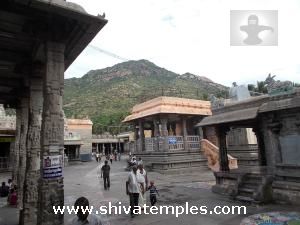
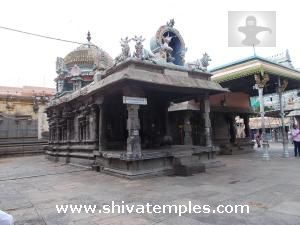
The Arunachaleswarar Temple comprises six prakarams, nine majestic gopurams, numerous mandapams, and several sannidhis, making it one of the most significant pilgrimage centers in South India. The Swayambhu Linga of Arunachaleswarar is adorned with a sacred serpent (nagam) and beautifully draped in pristine white garments. Behind the main sanctum stands the image of Lingodhbhavar, signifying this temple as the very place where the deity first manifested in that divine form. The Divine Mother, Goddess Unnamalai Ammai, has a separate shrine located to the left of the sanctum of the presiding deity.
The Gopurams
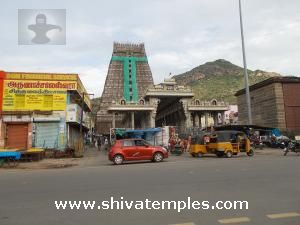
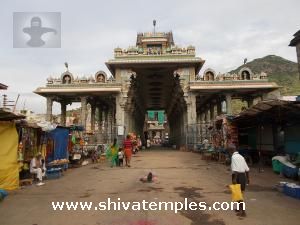
The temple is adorned with four magnificent gopurams, one on each side, serving as grand entrances to the complex. Within the temple premises, there are four additional gopurams, along with another smaller one in the east known as the “Kili Gopuram”, which provides access from the fourth prakaram to the third prakaram. The Rajagopuram on the eastern side is particularly majestic — standing 217 feet tall with 11 tiers, it is the second tallest gopuram in Tamil Nadu. The southern gopuram is known as the “Tirumanjana Gopuram”, the western gopuram as the “Pei Gopuram”, and the northern one as the “Ammani Ammal Gopuram.”
Girivalam - The Sacred Circumambulation
The Sacred Hill
Arunachalam, the sacred hill rising majestically to a height of 2,668 feet, is also known by several other revered names such as Mukthipuri, Arunagiri, and Sonagiri. Devotees undertake the holy practice of Giri Valam — the circumambulation of the Arunachaleswarar Temple and the Arunachala Hill, covering a distance of about 14 kilometers. This sacred act, performed throughout the year and especially on Pournami (Full Moon) days, is regarded as a simple yet profound path of yoga and devotion, leading one toward spiritual liberation.
Full Moon Significance
The sacred Arunachala Hill is believed to be the abode of countless Siddhars (enlightened beings). Hence, performing Giri Valam, particularly on Full Moon (Pournami) days, is regarded as highly auspicious. It is said that on these nights, numerous Siddhas descend upon the hill, and the gentle breeze that passes through the herbal plants and sacred trees growing along its slopes carries divine energy — calming the mind and imparting healing benefits to all who undertake the holy walk. Even today, hundreds of thousands of devotees continue this ancient and sacred tradition, circumambulating the hill on every full moon day to offer their reverence to Annamalai and receive the spiritual blessings and well-being that accompany this practice.
Ashta Lingams
Along the 14-kilometer path encircling the Arunachala Hill, there are eight small shrines of Lingams collectively known as the Ashta Lingams - Indra Lingam, Agni Lingam, Yama Lingam, Niruthi Lingam, Varuna Lingam, Vayu Lingam, Kubera Lingam, and Esanya Lingam. They represent the eight directions and are an integral part of the Giri Valam worship. The Aadhi Annamalai Temple, glorified in the Thevaram hymns, is located along the right side of the path around the hill, further enriching the spiritual sanctity and historical importance of Arunachalam.
Chakra Connection - Manipura Chakra
According to yogic philosophy, there are six primary energy centers (chakras) within the human body. The Manipura Chakra, located in the navel or stomach region, is associated with Tiruvannamalai. As all living beings depend on food for sustenance, it is believed that the divine energy governing nourishment and life itself emanates from this sacred center. Thus, Annamalayar is revered as the embodiment of the cosmic Manipura Chakra, symbolizing that the movement and sustenance of the entire universe are encompassed within His divine essence — the stomach of Annamalayar.
Arupadai Veedu of Vinayaka
The six sacred abodes (Arupadai Veedu) of Vinayaka:
- Tirumudukundram
- Tirvannamalai
- Tirunarayur
- Tirukadayur
- Pillayar Patti
- Uchi Pillayar, Tiruchi
Pancha Bootha Sthalangal
The Pancha Bhootha Sthalangal are five sacred temples of Shiva, each representing one of the five fundamental elements of nature — Earth, Water, Fire, Air, and Space. These elements form the very basis of creation. These temples are located at:
- 1. Tiruvannamalai – Fire
- 2. Kancheepuram – Land
- 5. Chidambaram – Sky
- 3. Tiruvanaikaval – Water
- 4. Sri Kalahasti – Air
The Arunachaleswarar Temple at Tiruvannamalai is one of the largest and most revered temples in Tamil Nadu. It is one of the five magnificent temples associated with the five fundamental elements of nature, collectively known as the Pancha Bhoota Sthalangal.
Gallery - Arunachaleswarar Temple