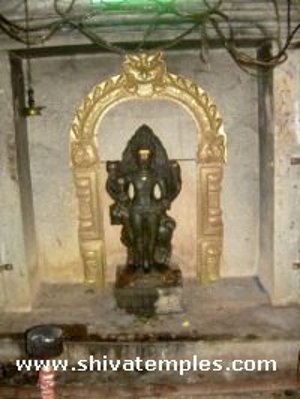
Azhagiyanathar Temple, Tiru Aamaathur
Location
Tiru Aamaathur
Deity
Aamatheeswarar, Azhagiyanathar, Abhirameswarar
Female Deity
Muthaambikai
Pathikam
Sambandar - 2, Tirunavukarasar - 2, Sundarar -1
Gallery - Azhagiyanathar Temple


How to Reach
This Shiva temple is located about 7 km northwest of Villupuram, along the Villupuram–Tiruvannamalai Road. From Villupuram, travel approximately 2 km on the Villupuram–Tiruvannamalai–Gingee (Chenji) bus route until you see a signboard for “Thiruvamaathur”. Turn left at this junction and continue for about 6 km to reach the temple. The Villupuram–Surappattu town bus also passes through Thiruvamaathur, providing convenient access. Villupuram is well connected by road and rail and is situated about 160 km from Chennai.
Temple Address
Tiruvamathur
Tiruvamathur Post
Viluppuram Taluk
Viluppuram District
PIN – 605402
Temple Hours
Morning : 6:00 - 12:00
Evening : 4:00 - 8:00
Nearby Paadal Petra Shiva Temples
Temple Legend
Tri-Glories
This Shiva temple at Aamathur is renowned for its threefold sacredness — its Sthalam (divine site), Murthi (presiding deity), and Theertham (holy water body).
In ancient times, cows were created without horns. To safeguard themselves from wild predators, Kamadhenu, the divine cow, along with other cattle, approached Nandi Deva seeking protection. Moved by their plea, Nandi advised them to go to a forest rich with Vanni trees on the banks of the Pampa River and worship God Shiva there. Following his guidance, the cows reached the forest and discovered a Swayambhu (self-manifested) Linga. With deep devotion, they performed intense penance for several days. Pleased with their sincere prayers, Shiva blessed them with horns, granting them both strength and protection.
The Name 'Aamathur'
The name “Aamathur” originates from the sacred act of worship performed by the cows — “Aa” meaning cow in Tamil. According to the Sthala Purana, those who speak about this temple or even listen to the glory of this holy Sthalam are believed to be blessed with divine grace.
Sage Bhringi and the Vanni Tree
Sage Bhringi was a staunch devotee of Shiva, worshipping Him alone to the exclusion of all others. When Shiva and Parvathi united in the divine form of Ardhanarishvara, symbolizing the inseparable union of masculine and feminine energies, Sage Bhringi still desired to worship only Shiva’s half. Transforming himself into a female beetle (Bhringi), he flew through a small crevice, circumambulating solely around Shiva’s portion, disregarding Parvathi. Feeling slighted by his act, Goddess Parvathi cursed the sage to become a Vanni tree at this sacred spot. From that time onward, the Vanni tree has been revered as the Sthala Vruksham (sacred tree) of this temple.
Temple Layout
Two Separate Temples
There are two temples in Tiruamathur. The principal temple, dedicated to Aamatheeswarar, features a majestic seven-tiered (7-tier) Rajagopuram and faces east, enclosed within a strong and beautifully constructed compound wall. The second temple, dedicated to Goddess Muthambikai, faces west and is adorned with an elegant five-tiered (5-tier) Gopuram.
Aamatheeswarar Temple - Main Structure
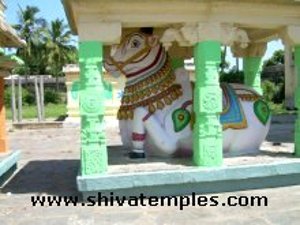
A majestic Nandi greets devotees as they enter through the gateway into the outer prakaram. Within this precinct are several noteworthy sannidhis dedicated to Siddhi Vinayaka, Shanmukha, and Esanya Lingeswara. In the north-eastern corner stands the image of Achutharayar, who played a significant role in renovating this temple — his statue remains a tribute to his devotion and contribution.
Inner Prakaram
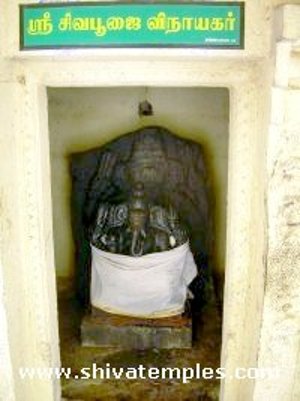
A flight of steps near the Siddhi Vinayaka Sannidhi leads to the inner prakaram. At the landing stands the Nataraja Sabha, facing south. This prakaram houses numerous sannidhis, including those of the 63 Nayanmars, Kalabhairava, Dakshinamurthy, Sanakathi Rishis, Saptha Mathas, Sri Rama, Muruga, and Goddess Lakshmi. A unique sculpture here depicts Vinayaka performing Shiva Puja — a rare and delightful sight.
The Presiding Deity
The sanctum is surrounded by a trench-like structure, with colorful Dwarapalakas adorning either side of its entrance. The presiding deity, Lord Abhirameswarar, is a Swayambhu Linga, also known as Azhagiyanathar. The Linga bears a distinct hoof mark resembling a crescent moon — a divine sign of worship offered by sacred cows. This mark gives the Linga a gentle leftward inclination. It is also believed that Lord Rama worshipped here, bestowing upon the deity the name Abhirameswarar.
Mathanga Theertham
Within the temple premises lies the sacred Mathanga Theertham, created by Sage Mathanga. It is believed that even sprinkling a few drops of its holy water bestows immense punya (spiritual merit) upon devotees.
Goddess Muthambikai Temple
Upon entering the outer prakaram of the Goddess’s temple, devotees encounter the dwajasthambam, balipeetam, and a lion, symbolically replacing Nandi. The inner gateway is adorned with beautifully painted Dvarapalakis, leading to the west-facing sannidhi of Goddess Muthambikai, who radiates divine grace and serenity upon all who seek her blessings.
The Sacred Vattaparai (Circular Rock)
Historical Significance
In the southern part of the prakaram surrounding the sanctum of Goddess Muthambikai lies a circular rock known as Vattaparai, accompanied by a Shiva Linga. According to ancient lore, this rock holds immense sanctity as it marks the very spot where Lord Rama and Sugriva entered into a solemn pact, witnessed by Hanuman, before the battle against Vali.
Among the local community, it remains a long-standing tradition to resolve disputes by taking an oath before this sacred rock. Revered as a divine witness, it is believed that anyone who speaks falsehoods before it will inevitably face severe and irreversible consequences.
The Story of Two Brothers
The significance of the Vattaparai sannidhi is also tied to an age-old tale of betrayal and divine justice involving two brothers. The younger brother, upon discovering that his elder brother had deceitfully acquired his property, confronted him and demanded its rightful return. When the elder brother refused, the younger sought justice from the village council.
The council instructed the elder brother to swear an oath at the shrine of Vattaparai Amman to prove his innocence. Craftily, the elder brother gathered gold equivalent to his sibling’s lost assets and concealed it within the ornamental knob of his walking cane. Appearing before the council, he handed the cane to his younger brother and falsely swore—with empty hands—that he possessed none of his brother’s property.
Divine Justice
Unaware of his deceit, the villagers and the council dismissed the younger brother’s plea. The elder brother, pleased with his deception, took back his cane and traveled about 9 kilometers to the Thumbur Nagamman Temple. There, he boasted that even the Goddess’s power could not harm him.
At that very moment, divine retribution struck—a venomous black serpent emerged and fatally bit him. To this day, a statue of a snake stands at the site as a reminder of this event. Moreover, an imprint resembling a serpent’s tail can still be seen on the chest of Goddess Muthambikai, serving as a sacred testimony to the incident. Devotees seeking further insight into this divine occurrence may approach the temple’s Sivachariyar for guidance.
Pathigam
There are five Pathigams (hymns) composed in praise of the presiding deity, Lord Abhirameswara.
- Tirugyanasambandar - 2 pathigams
- Tirunavukkarasar - 2 pathigams
- Sundarar - 1 pathigam
The Irattai Pulavargal (twin poets) have also composed a Kalambakam — a poetic work — in praise of the presiding deity, Abhirameswara.
Gallery - Azhagiyanathar Temple