Masilamani Easwarar temple, Tiru-Mullai-Vayil
Location
Tiru-Mullai-Vayil, near Ambattur in Chennai
Deity
Masilamani Eshwarar
Female Deity
Kodiyidai Amman
Pathikam
Sundarar - 1
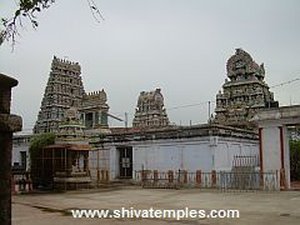
Gallery - Masilamani Easwarar Temple


How to Reach
This Shiva temple is about 2 km from Ambattur, the industrial hub of Chennai, and is well connected by road. From Tirumullaivayil railway station on the Southern Railway Chennai Central – Arakkonam section, the temple is about 1.5 km away. Visitors can easily reach the temple from the station by auto-rickshaw or local buses.
Temple Address
Thirumullaivoyal Post
Tiruvallur District
PIN – 609113
Temple Hours
Morning : 6:30 - 12:00
Evening : 4:00 - 8:00
Temple Overview
History and Significance
There are two Paadal Petra Sthalams with the name Tirumullaivayil. To differentiate them, the one located in Thondai Nadu is known as Vada-Tirumullaivayil, and the other one near Sirkazhi (Sirkazhi) is known as Then-Tirumullaivayil (North of river Cauvery).
This historic temple, which has existed for nearly 1200 years, is celebrated by Sundarar in his pathikam. Following the loss of his sight in Tiruvotriyur, Sundarar traveled to Tirumullaivayil, where he composed an 11-stanza pathikam in honor of the temple's deity.
Temple Architecture
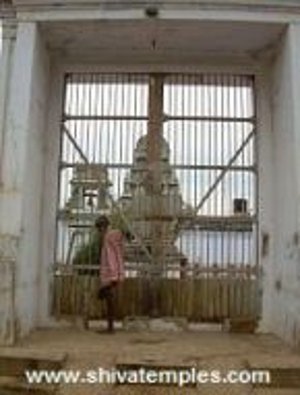
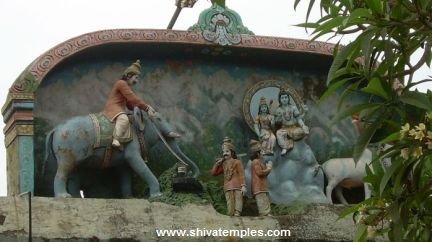
The prominent gopuram at the southern entrance serves as the main access point to the temple, while the eastern entrance remains inactive. Upon entering through the southern gateway, visitors first come into an enclosure supported by 15 pillars, where Prasanna Vinayaka welcomes devotees. Behind the Prasanna Vinayaka sannidhi, a sculpture illustrating the temple’s legend can be seen on the wall — it depicts a king cutting a creeper with his sword, with a Shivalinga situated beneath it. Proceeding through another inner gateway, visitors reach the sanctum of the goddess Kodi Idai Nayaki, which faces east. Further ahead lies the sanctum of the principal deity, Masilamani Eeshwarar, also oriented towards the east. This architectural arrangement is significant, as Eeswaran and Ambal are positioned adjacent to each other, with Ambal situated on the right side. The vimana above the sanctum is intricately designed in the form of the rear of an elephant, a style known as Gajaprushtam. In addition, the temple’s sacred tank, Kalyana Theertham, is located outside the temple premises, on the right side of the southern entrance.
The Swayambhu Linga
The principal deity, Masilamani Eeshwarar, is worshipped in the form of a swayambhu (self-manifested) Linga. A distinctive cut mark from a sword can be seen on the Linga, associated with the temple’s legend. Because of this mark, the deity is always covered with sandalwood paste to protect and preserve it. Every year, during the Tamil month of Chitirai, on the auspicious day of the Sadhaya star, the existing sandalwood paste is carefully removed and replaced with a fresh layer as part of a special ritual. It is also noteworthy that the ceremonial Abhishekam (ritual bathing) is performed only for the Avudayar, the sacred pedestal or base of the deity, and not directly on the Linga.
Kodiyudai Amman – Kriya Shakti
In Chennai, three temples dedicated to different aspects of Goddess Shakti are especially revered for their spiritual importance: Thiruvudai Amman Temple – associated with Ichcha Shakti (the power of divine will), Vadivudai Amman Temple – associated with Gyana Shakti (the power of knowledge), Masila Maneeswarar Temple Tirumullaivayil – where Goddess Kodi-Idai-Nayaki is worshipped as Kriya Shakti (the power of action). It is considered highly auspicious to have darshan of all three goddesses on the same day—particularly on a full moon (Pournami) day, and even more special if the full moon falls on a Friday. Tradition also holds that Thiruvudai Amman, Vadivudai Amman, and Kodiyidai Amman were sculpted by the same artisan, which is why their divine forms share a similar appearance.
Inner and Outer Prakaram
The Nandi here has a unique posture. Instead of facing the main deity, it is positioned outward toward the east, as if ready to support King Thondaiman, which is associated with the temple’s legend. In the prakaram surrounding the sanctum, devotees can see the idols of the four principal Nayanmars along with all 63 Nayanmars. On the northern side of this prakaram is the Nataraja Sabha, which faces south. Other sannidhis found within the prakaram include those of Dwarapalakas, King Thondaiman, Neelakanta Shivacharya, and Mahavishnu with his consorts Sreedevi and BhooDevi. Nearby, there is also a ‘Rasa’ Shivalinga, made from a mixture of mercury and silver, which was consecrated at a later period.
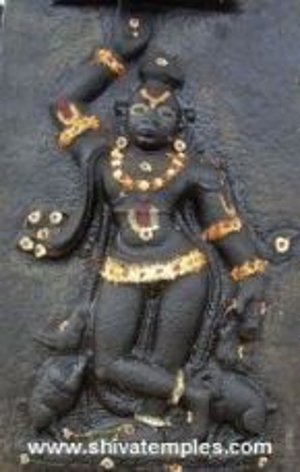
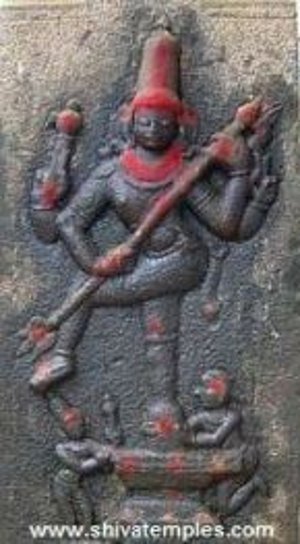
Saint Arunagirinathar, the renowned poet-saint and devotee, composed three beautiful hymns in praise of Lord Muruga in his celebrated work Tiruppugazh. In the northern outer prakaram of the temple, there is a dedicated east-facing sannidhi where Muruga appears with four divine arms, accompanied by his consorts Valli and Deivanai. In the eastern outer prakaram, a separate south-facing sannidhi is present for Bhairava. Notably, this temple does not have a sannidhi for the Navagrahas, the nine celestial deities. According to ancient legends, the revered sage Vasishta chose this sacred place for his penance, through which he was blessed with the divine cow Kamadenu. The Dwajasthambam, Balipeetam, and Nandi are aligned in a straight line with the eastern entrance of the temple.
Temple Legend
King Thondaiman and the Hidden Shivalinga
King Thondaiman, the ruler of Thondai Nadu with Kanchipuram as his capital, once faced a fierce battle against the Kurumbars led by Onan and Kanthan, who served King Vanasuran. After suffering a setback in the war, Thondaiman was returning from the battlefield on his royal elephant when an unexpected incident occurred. The elephant’s legs became entangled in mullai, a creeper known as Juhi jasmine. While trying to free the elephant, the king cut the creeper with his sword. To his amazement, blood began to flow from beneath it. When he looked closer, he discovered a sacred Shivalinga hidden under the creeper. At that moment, Lord Shiva appeared before him, blessed the king, and sent Nandi, his divine bull, to assist him in the battle. With the support of Nandi, King Thondaiman went on to defeat his enemies. In gratitude for this divine help, he built a temple at Thiruvadamullaivayil (Tirumullaivayil) to honor the Deity. See also – Onakanthantali, a sacred place named after Onan and Kanthan.
Pathigam
The pathikam (hymn) on this temple was composed by Sundarar and is included in the sacred Saiva canon known as the Tirumurai. After losing his sight at Tiruvotriyur, Sundarar came to Tirumullaivayil, where he sang an 11-stanza pathikam in praise of Masilamani Eeshwarar.
Gallery - Masilamani Easwarar Temple