Manikandeswarar temple, Tirumarperu
Location
Tirumarperu (better known as Tirumalpur)
Deity
Manikandeswarar, Maalvanangeeswarar
Female Deity
Anjanakshi, Karunai Nayaki
Pathikam
Tirunavukarasar - 4, Sambandar - 2
Gallery - Manikandeswarar Temple

How to Reach
This Shiva temple is 21 Kms from Kancheepuram on the Kancheepuram - Arakkonam route. Bus facilities are available from both Kancheepuram and Arakkonam.
Temple Address
Thirumalpur Post
Arakkonam Taluk
Vellore District
PIN – 631053
Temple Hours
Morning : 7:00 - 12:00
Evening : 5:00 - 8:00
Nearby Paadal Petra Shiva Temples
Temple Legend - Mahavishnu's Worship
For King Kuban, Mahavishnu once fought a fierce battle against Sage Dutheechi, whose body possessed such extraordinary strength that the edges of Vishnu’s Sudarshan Chakra shattered upon striking him. Seeking a new chakra from Shiva—the very divine weapon that had previously destroyed the demon Chalandra—Mahavishnu came to this sacred site, once worshipped by Devi Parvathy, and undertook intense penance by offering one thousand lotus flowers to the Shiva Linga every day. To test the depth of His devotion, Shiva concealed one of the flowers. When Mahavishnu discovered that His offering was incomplete, He willingly plucked out one of His own eyes, revered as being as beautiful as a lotus, and offered it in place of the missing flower. Deeply moved by this unparalleled act of devotion and sacrifice, Shiva manifested before Mahavishnu, restored His eye, and bestowed upon Him the divine Chakra. Since Mahavishnu received the sacred weapon here through His worship, the place came to be known as Tirumarperu, later called Tirumalpur. This legend is also associated with the temple of Tiruveezhimalai, and is commemorated in the temple’s Utsava idol of Mahavishnu, who is depicted holding a lotus in one hand and His eye in the other.
Devi Parvathy's Penance
According to legend, during a playful moment, Devi Parvathy gently covered the eyes of Shiva, causing the entire universe to be engulfed in darkness and brought to a standstill. Realizing the consequences of her action, she sought to atone by descending to Earth and performing penance. On the northern bank of the Vrudhaksheera River, also known as the Paalaru, she fashioned a Shiva Linga from sand and worshipped it with great devotion. This sand-formed Linga continues to be revered at the temple, and because of its delicate composition, it is protected with a copper-plated covering before ritual ablutions are performed.
Temple Layout and Architecture
Temple Complex
This Shiva temple spans an expansive area of about 1.2 acres and is distinguished by its imposing five-tiered east-facing gopuram. The complex is enclosed by sturdy perimeter walls and comprises two concentric prakarams. Adjacent to the temple lies the sacred water body known as Chakra Theertham, which adds to the spiritual significance of the site.
Main Entrance Features
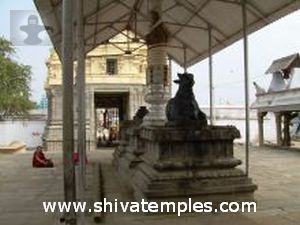
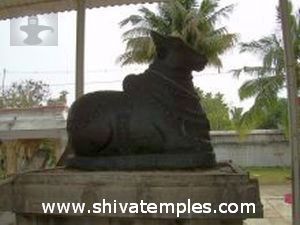
The dwajasthambam, balipeetam, and Nandi are aligned along the temple’s central axis facing the entrance. An inner gateway leads to the east-facing sannidhi of the main deity. Opposite the presiding deity, Nandikeshwar and Senthaamarai Kanna Perumal stand with folded hands in a posture of deep reverence.
Peripheral Sannidhis
The inner prakaram houses additional sannidhis dedicated to Vinayaka, Chidambareshwar, Somaskandar, Subramanya, Chandikeshwarar, Nataraja, and Gajalakshmi. As the main deity is represented by a sand-made linga, the ritual of Annabishekam—the ceremonial anointing with rice—is performed instead for Chidambareshwarar. This sacred observance takes place during the Tamil month of Ippasi.
Sanctum Architecture and Deities
Guardian Deities
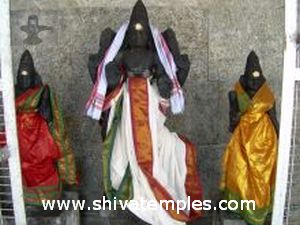
Vallabha Vinayaka and Shanmukha serve as the guardians at the entrance to the sanctum, with Vallabha Vinayaka uniquely depicted with ten arms. Directly opposite the main deity’s sanctum stands the sannidhi of Mahavishnu, portrayed in a Namaskara posture with folded hands. This shrine is crowned with an ornate vimanam, and Nandi is positioned reverentially in front of it.
Mandapam Sculptures
Upon entering the sanctum, one encounters a mandapam supported by intricately carved pillars, adorned with sculptural representations of various deities and revered figures. These include Dakshinamurthy, Surya, Mahavishnu, Balasubramanyar, Appar, Sundarar, Tirugnanasambandhar, Vinayaka, Muruga, Brahma with his four faces, Devi worshipping Shiva beneath a Vilva tree, Kalinganarthanam, Kamadhenu, Bhairavar, and Veerabhadrar.
Goshta Murthas
The walls surrounding the sanctum are adorned with goshta murthis of Dakshinamurthy, Mahavishnu, Brahma, and Goddess Durga, the latter being depicted with eight arms and holding the conch and chakra. Following the Deepa Aradhana offered to Mahavishnu, the temple observes the unique Vaishnavite tradition of placing the Sadari on the heads of devotees.
Pathikam and Literary Heritage
Sacred Hymns
Six Thevaram Pathikams have been dedicated to the presiding deity of this temple, with two hymns composed by Tirugyanasambandhar and four by Tirunavukkarasar (Appar). The revered Periya Puranam, authored by Sekkizhar, records that Sundarar also visited and worshipped at this temple. However, although tradition affirms that Sundarar composed a Pathikam in praise of the deity, that hymn has unfortunately not survived the passage of time and remains lost to history.
Map connecting Tiruvalangadu, Tiruvirkolam, Elambayankottur, Thakkolam and Tirumarperu.
Gallery - Manikandeswarar Temple