Vedapureeswarar temple, Tiruvazhundur
Location
Tiruvazhundur (now known as Therazhundur)
Deity
Vedapureeswarar
Female Deity
Soundaraambikai
Pathikam
Sambandar - 1
Gallery - Tiruvazhundur Temple


How to Reach
This Shiva temple is located at Therazhundur (formerly known as Tiruvazhundur), about 15 kilometers from Mayiladuthurai. Regular bus services are available from Mayiladuthurai to Therazhundur.
Temple Address
Therazhundur
Therazhundur Post
Mayiladuthurai Taluk
Mayiladuthurai District
PIN – 609805
Temple Hours
Morning : 7:00 AM - 12:00 PM
Evening : 4:00 PM - 8:00 PM
Nearby Paadal Petra Shiva Temples
Nearby Divya Desams
Sthala Purana - The Divine Curse and Ordination
According to the Sthala Puranam, while Shiva and Mahavishnu were engaged in a game of dice, with Parvati serving as the referee, a dispute arose regarding the outcome of a throw. When Shiva sought Parvati's judgment, she ruled in favor of Mahavishnu. Angered by her decision, Shiva cursed her to be born on earth in the form of a cow, destined to wander the land in penance until she was reunited with Him. It was at Thiruvazhundur that Shiva ordained Goddess Uma to assume this earthly form. Separated from His divine consort, Shiva came to this place disguised as an Andanar (Vedic Brahmin) and sat beneath a tree, reciting and imparting the wisdom of the Vedas. Owing to this divine act, He came to be worshipped here as Vedapureeswarar. This site was also sanctified by the worship of Sage Agastya, Sage Markandeya, and Goddess Kaveri, who offered their prayers and received the grace of the presiding deity.
Temple Structure
Temple Location and Gopuram
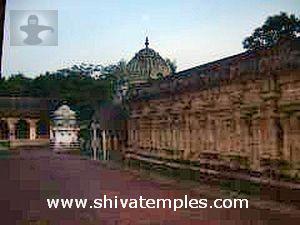
The Vedapureeswarar Temple is situated on the eastern side of Thiruvazhundur (Therazhundur), while to its west stands the renowned Maha Vishnu Temple, one of the sacred 108 Divya Desams. The temple is oriented westward and is adorned with a majestic five-tiered Rajagopuram, enclosing two spacious prakaras (circumambulatory corridors) within its sacred precincts.
Outer Prakara
Entering through the main gateway, devotees arrive at a spacious outer prakara that serves as the temple's circumambulatory corridor. Near the second entrance, which leads into the inner prakara and the sanctum of the presiding deity, Vedapureeswarar, are the customary Kodimaram (flagstaff), Bali Peetam (altar of offerings), and Nandi, all aligned in accordance with traditional Shaivite temple architecture. In the northwestern corner of the temple stands a separate sannidhi dedicated to Sri Mateshwarar and Sri Mateshwari. According to local tradition, this is believed to be the original temple at the site, while the sanctum of Vedapureeswarar is said to have been consecrated during a later period.
Inner Prakara
Proceeding around the inner prakara, devotees first come to the sannidhi of Muruga with Valli and Deivanai in the northwestern corner. In the opposite northeastern corner is the Navagraha sannidhi. Nearby are the shrines of Goddess Kaveri, Surya, and Kalabhairava, each enshrined in accordance with the traditional layout of the temple.
Sthala Vriksha - The Sandalwood Tree
The temple's Sthala Vruksham, the sacred sandalwood tree, is situated in the eastern prakara. According to the Sthala Puranam, it was beneath this venerable tree that God Shiva, in the guise of a Vedic Brahmin, expounded the Vedas. Commemorating this divine event, a Kshetra Linga and Nandi have been installed beneath the tree, symbolically preserving the sanctity of the legend.
Other Sannidhis
The sannidhi of Valanchuzhi Vinayaka is situated along the southern prakaram. Opposite the sannidhi of Sri Mateshwarar stands the separate east-facing sanctum of Goddess Soundarambikai.
Origin of the Name - Ther-Azhundur
According to the Sthala Puranam, Brahma presented a celestial flying chariot to the Mazhava king Urdhva Varathan. While journeying through the skies, the chariot suddenly came to an inexplicable halt over a particular spot and could not be moved despite the king's efforts. After remaining suspended for some time, it descended to the ground on its own. Astonished, the king explored the area and discovered Sage Agastya deeply immersed in penance. Realizing that the extraordinary spiritual power of the sage's austerities had prevented the chariot from proceeding further, he paid his respects to the sage. Since the chariot (Ther) came to a standstill (Azhundhu) at this place, the village came to be known as Ther-Azhundur. In his Thevaram hymns, Saint Thirugyanasambandar refers to the place as Azhundai, which gradually evolved into the present-day name Azhundur.
Gallery - Tiruvazhundur Temple