Rathnagirinathar temple, Tiruvaatpokki
Location
Tiruvaatpokki (Rathnagiri)
Deity
Rathnagirinathar, Vaatpokki Nathar, Sokkar
Female Deity
Surumbarkuzhali
Pathikam
Tirunavukarasar - 1
Gallery – Rathnagirinathar Temple, Tiruvaatpokki

How to Reach
Located at Ayyarmalai, this Shiva temple lies about 10 km from the Kulithalai Bus Stand. Kulithalai is well connected by rail and is situated on the Karur–Tiruchirapalli section of the Southern Railway network, making the temple easily accessible by train. Visitors can also reach Kulithalai by frequent bus services operating from nearby cities such as Tiruchirapalli (Trichy), Karur, and Erode. From Kulithalai, local transport facilities are available to reach the temple.
Temple Address
(Vatpokki) Ayyarmalai
Sivayam Post
(Via) Vaiganallur
Karur District
PIN – 639124
Temple Hours
Morning : 10:00 - 5:00
Evening : Margazhi: 4:00 AM - 5:00 PM
Nearby Paadal Petra Shiva Temples
Temple Description
Temple Layout
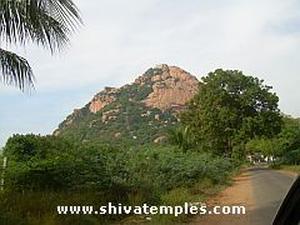
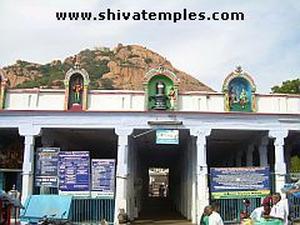
The temple at Tiruvatpokki is majestically situated atop a hill and is renowned for its unique spiritual and architectural features. The presiding deity, Ratnagireeswarar—also worshipped as Malaikozhundeesar and Madhyayana Chokkar—faces west, while Goddess Surumbarkuzhali graciously faces east, an uncommon arrangement in Shiva temples. The presiding deity is enshrined as a self-manifested (Swayambhu) Lingam, believed to have appeared on the ninth rock amidst eight surrounding rocky formations. The temple complex also contains separate sannidhis for Dakshinamurthy, Nataraja with Sivakami, Subramania, and Vairaperumal. At the foot of the hill are sannidhis dedicated to Pradhana Vinayaka and Anjaneya, where devotees traditionally offer their prayers before ascending to the main temple.
Sacred Geography & Mystical Features
Interestingly, the temple and its surroundings are shaped like 'Pranava', the sacred syllable 'Aum', earning it the name Shivaya-Malai. The temple's sacred tree, a neem tree, holds special significance as it is believed to have been created by the celestial god Indra. The temple has long been a site of worship and pilgrimage for various divine beings and sages, including Durga, Indra, Sayantan, Surya, Vayu, Adiseshan, Sages Uromesa and Agasthiya, and the Saptha Kanyas, all of whom are said to have sought the blessings of the deity here.
The Climb & the Sanctum
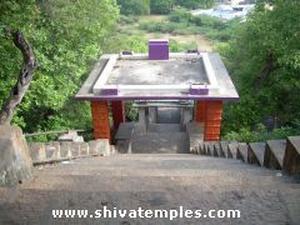
Devotees can reach the hilltop temple by ascending a flight of 1,140 well-laid stone steps. The main stairway, constructed in 1783 CE, consists of 952 steps and is punctuated by a series of mandapams that provide resting places for pilgrims during the climb. The sacred journey begins at the foothill with worship at the sannidhi of Pradhana Vinayaka, followed by a beautifully ornamented entrance arch and a sannidhi dedicated to the four principal Nayanmars. A sannidhi for Anjaneya is also located at the base of the hill. After climbing the first 75 steps, pilgrims encounter a mysterious rock known as Ponnidum Parai. Further along, at around the 750th step, lies Ugandam Padi, where sannidhi dedicated to Vinayaka and Goddess Surumbarkuzhali, who faces east, are situated. From there, devotees continue their ascent around the hill to reach the sacred abode of Vatpokkinathar (Rathnagireeswarar). Within the temple, devotees are first greeted by the sannidhi of Dakshinamurthy before proceeding to the west-facing sanctum of the presiding deity. One of the temple's remarkable features is the phenomenon that occurs during Maha Shivaratri and the days surrounding it, when the rays of the sun enter through a specially positioned opening and fall directly upon the Shiva Linga. Adding to the temple's sanctity, water from the sacred Cauvery River is brought daily in ten pots for the Uchikala Abhishekam performed to Rathnagireeswarar, a time-honoured ritual that continues to uphold the temple's profound spiritual heritage.
Temple History & Legend
The Legend of the Gem
According to the temple's legend, a king once performed intense penance, praying earnestly to Shiva for the blessing of a precious gemstone. Moved by his devotion, Shiva appeared before him in the guise of an Andhanan (a Brahmin) and pointed to a water trough, instructing the king to fill it with water from the River Cauvery. He assured the king that bathing in the filled trough would grant his wish. The king made repeated attempts to fill the trough, but despite his best efforts, he was unable to do so. Frustrated and unable to understand the reason for his failure, he became angry and drew his sword to strike the mysterious Brahmin. At that very moment, Shiva revealed His true divine form and stopped the king from carrying out the act. Realizing his mistake, the king sought forgiveness. Pleased with the king's devotion and repentance, Shiva granted him the precious gem he had long desired. As a result, the deity came to be worshipped as Rathnagireeswarar (Rathnagiri Nathar), meaning "Lord of the Gem Mountain." The place came to be known as Vatpokki, derived from the Tamil words referring to the king raising (pokki) his sword (vaal) at this sacred spot. Even today, devotees believe that a mark resembling a sword scar can be seen on the Shiva Lingam, commemorating this remarkable divine encounter.
The Battle of Vayu & Adishesha
The hill is said to have once been part of the sacred Mount Meru. Legend has it that during a fierce battle between Vayu, the god of wind, and Adishesha, the serpent deity, the Tiruvatpokki hill was torn from Mount Meru by the sheer force of Vayu's power, coming to rest at its present location on the banks of the Cauvery.
The Legend of the Crow
According to a well-known local legend, a crow once overturned the milk that a devotee had brought to offer to Vatpokki-Nathar. As punishment, the deity commanded that the crow be burned, and ever since, crows have refused to fly over the summit of the hill where this temple is located – giving rise to its colloquial name, "the hill avoided by crows." Observers have indeed noted the peculiar absence of crows in the airspace above the hill's peak, lending credence to this folkloric tale. The pathikam composed by Tirunavukkarasar in honour of this temple appears in the 5th Tirumurai.
The Triveni Pilgrimage Tradition
Tiruvatpokki forms part of a revered pilgrimage circuit involving three ancient Shiva temples located in the Kulithalai region of present-day Karur district: Tirukadambanthurai, Tiruvatpokki, and Tiru-Eengoi-Malai. Devotees who worship at all three temples on the same day are believed to receive immense spiritual merit and divine blessings. The pilgrimage is ideally undertaken in a prescribed sequence: Tirukadambanthurai in the morning, Tiruvatpokki at noon, and finally the Maragadhachaleshwarar Temple at Tiru-Eengoi-Malai in the evening. The 'Uchikala' Pooja, the mid-noon worship conducted at Tiruvatpokki, is considered especially beneficial, as it is said that Sage Agastya himself worshipped the presiding deity here at mid-day. Of the three temples, Tiruvatpokki and Tirukadambanthurai are classified among the Paadal Petra Sthalams located south of the River Kaveri, while Tiru-Eengoi-Malai belongs to the group of temples situated north of the river.
Gallery – Rathnagirinathar Temple, Tiruvaatpokki