Kasiviswanathar temple, TiruKudanthai Kaaronam
Location
TiruKudanthai Kaaronam (Kumbakonam)
Deity
Kasiviswanathar
Female Deity
Visalakshi, Thenaar Mozhiyal
Pathikam
Sambandar - 1
Gallery - TiruKudanthai Kaaronam


How to Reach
This sacred Shiva temple is situated in the heart of Kumbakonam. The Kasi Viswanathar Temple stands on the northern bank of the Mahamaham tank, while the Someswarar Temple lies on the southern bank of the Pottramarai tank, close to the renowned Kumbeswarar Temple.
Temple Address
Tirukkudanthai Kaaronam
Kumbakonam
Thanjavur District
PIN – 612001
Temple Hours
Morning : 6:00 - 12:00 PM
Evening : 4:00 - 8:00 PM
Point of Views
One opinion identifies the Kasi Viswanathar Temple, situated on the northern bank of the Mahamaham tank in Kumbakonam, as Thirukkudanthai Karonam in the Thevaram hymns. Another view associates the Somanathar (Someswarar) Temple, located on the southern bank of the Pottramarai tank near the Kumbeswarar Temple, which some believe to be the Thirukkudanthai Karonam praised in the hymns. Priests from both temples maintain that their respective temple is the one venerated in the Thevaram verses.
Origin of the Name "Karonam"
According to the sthala purana, this place came to be known as Karonam for several divine reasons. It is believed that before vanquishing Ravana, Rama worshipped God Shiva here and received the Rudra amsha—the divine essence of Rudra—which he absorbed into his own being. The name Karonam is said to have originated from the words Kaya (body) and Arokanam (attainment of Rudra's grace). Another tradition holds that during the Great Deluge (Mahapralaya), God Shiva united all souls with Himself at this very spot, signifying the ultimate union of all beings with the Divine. It is also believed that Goddess Ambikai merged Her divine essence with that of God Shiva here, symbolizing the eternal oneness of Shiva and Shakti. Together, these sacred legends have bestowed upon this temple the revered name Karonam.
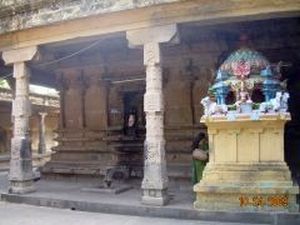
Kasi Viswanathar Temple Structure
Worship by the Nava Kannikas
This temple is venerated as the sacred site where the nine divine maidens (Nava Kannikas) once worshipped God Shiva. These maidens, who represent the holy rivers — Ganga, Yamuna, Godavari, Narmada, Saraswati, Kaveri, Tungabhadra, Krishna, and Sarayu — are believed to have approached the deity, expressing their sorrow that people cleanse their sins in their waters, leaving those impurities with them. Moved by their plea, Shiva comforted them and directed them to bathe in the holy Mahamaham tank at Kumbakonam, where all their impurities would be purified. Shiva then manifested on the northern bank of the Mahamaham tank as Kasi Viswanathar, accompanied by His consort Visalakshi.
Temple Layout
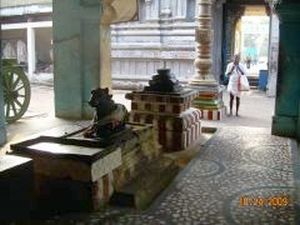
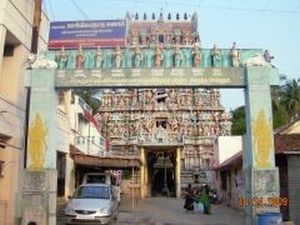
Above the entrance of the five-tiered Rajagopuram are exquisite stucco sculptures depicting God Shiva guiding the nine maidens to bathe in the sacred Mahamaham Tank. Passing through this majestic gateway, devotees first encounter the sannidhi of Kodimara Vinayaka and the temple flagstaff in the outer courtyard. Beyond this lies the hall housing the Bali Peetha and the sacred Nandi, which faces the sanctum in an attitude of eternal devotion.
Special Sannidhis
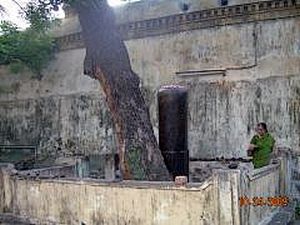
In the next courtyard are the sannidhis of the Nava Kannikas, and the Sapta Matrikas. The temple also enshrines the Maha Linga, believed to have been consecrated and worshipped by Rama before he set out on his expedition to Lanka. Situated in the northeastern corner of the temple, this imposing Shiva Linga is renowned for its towering form and is traditionally believed to be ever-growing, symbolizing the infinite and boundless energy of God Shiva.
Other Sannidhis
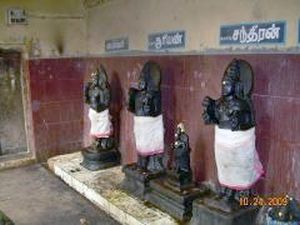
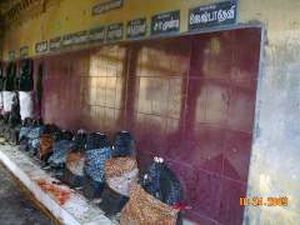
Within the temple premises, there are sannidhis dedicated to Bhairava, Surya, and Chandra, along with a sanctum for the Navagrahas (nine planetary deities). Dakshinamurthy blesses devotees from a separate sannidhi situated in a niche (Goshta) along the outer wall surrounding the sanctum.
Someswarar Temple Structure
Sthala Puranam (Temple Legend)
As the time of the Great Deluge (Pralaya) drew near, Brahma preserved the essence of creation—the divine nectar of immortality—within a sacred pot (Kumbha) and placed it atop the Himalayas. When the deluge engulfed the world and the rising waters submerged even the Himalayan peaks, the Kumbha floated southward upon the cosmic flood. As the waters gradually receded, the sacred pot came to rest at this holy spot, which thereafter became known as Kumbakonam, the revered Kudamooku.
Origin of the Shiva Lingam
When the sacred Kumbha came to rest upon the earth, God Shiva released an arrow that shattered the divine pot. The nectar of immortality contained within spilled onto the ground, and from the sand sanctified by this celestial nectar, He fashioned a Shiva Linga and infused it with His own divine presence. Thus, He came to be worshipped as Adikumbeswarar. Tradition further relates that when the Kumbha was struck, its binding thread (Uri) snapped and fell at another sacred spot, where a second Shiva Linga manifested. This Lingam was worshipped by Chandra, the Moon God, and the presiding deity of that shrine came to be known as Someswarar, meaning "the Lord worshipped by Soma (the Moon)."
Temple Layout
The temple features three entrances and a single prakaram (outer courtyard). Entering through the eastern Rajagopuram, devotees first offer worship to Maalisar and Goddess Mangalanayaki. As MahaVishnu is believed to have worshipped the deity here, He is known by the name Maal-Eesar. Proceeding through the Kattai Gopuram, devotees can have darshan of Somanathar and Thenaar Mozhi Ambikai. The northern entrance too leads directly to the sanctum of Someswarar and Somasundari.
Murugan Sannidhi
In this temple, Muruga is depicted seated gracefully upon His peacock mount, with one foot adorned by a sandal (patharaksha) — a unique and distinctive form seen only in the Someswarar Temple of Kumbakonam.
Tirugyana Sambandar's Pathigam
The hymn composed by Thirugnana Sambandar in praise of the deity of this temple appears in the First Thirumurai. In the seventh verse of this Pathigam, Sambandar reverently mentions Thenaar Mozhiyal, the divine consort of Someswarar. From this, it may be inferred that the Someswarar Temple is the Paadal Petra Sthalam referred to in this hymn.
Gallery